Formats and Guidelines
Meeting Scope and Tracks
Meeting Scope and Tracks
Meeting Theme
-
One Planet, Shared Future
Session Tracks
1. Environmental (Human and Ecological) Toxicology and Stress Response
Explores ecological and human health toxicology and response to environmental stress (biological, physical and chemical) in various systems. Encompasses in silico and in vitro tools and methods involving adverse outcome pathway (AOP), mode of action, molecular toxicology, -omics, animal alternative testing, quantitative structural activity relationship (QSARs), high-throughput techniques and emerging approaches for statistical toxicology.
2. Aquatic Toxicology, Ecology and Stress Response
Explores ecology, ecotoxicology and response to stress of all aquatic systems, including lentic and lotic freshwater systems, estuaries, coastal and marine environments.
3. Wildlife Toxicology, Ecology and Stress Response
Covers all life forms of wildlife not strictly aquatic (amphibian, reptiles, birds, mammals and other organisms) living in areas from the deserts to the tropics and everything in between.
4. Chemistry and Exposure Assessment
Comprises all aspects of chemical analysis, monitoring, fate and modeling, green chemistry and alternative chemical assessment.
5. Environmental (Human and Ecological) Risk Assessment
Evaluates risk to human and ecological receptors in aquatic and terrestrial environments from all potential stressors (physical, chemical, biological and biotechnological) towards the goal of integrated holistic assessment such as “One Health.”
6. Engineering, Remediation and Restoration
Addresses remediation and restoration of stressor-impacted air, water, and soil and sediment, including tools for predicting, monitoring and evaluation; technologies and methods for remediation and restoration; environmental engineering; green remediation; damage assessment; and strategies for management.
7. Policy, Management and Communication
Includes all aspects of science application in policy or regulations and management (regulatory science), as well as science communication to stakeholders in diverse audiences.
8. Systems Approaches
Uses cross- and trans-disciplinary approaches seeking to address complexity and large-scale issues by applying and integrating concepts such as life cycle assessment, sustainability, ecosystem services, impact assessment and environmental economics. Topics include regional and watershed-scale environmental management, climate change, resiliency and other related areas.
Meeting Format
Meeting Format
We are planning an in-person meeting with an on-demand component to be as inclusive as possible. Participants will be able to benefit from four days packed with scientific sessions, plenaries, courses, seminars and other exhibitor and networking events. Participants will be able to access on-demand content and recordings through the meeting platform for three months after the meeting. The conference will be held in English, including all presentations, sessions and official communications.
Virtual presenters will be able to upload posters or videos in advance. Poster presentations will be available on demand throughout and after the meeting. Platform presentations and plenaries approved for recording will be recorded on-site and posted for on-demand viewing within 24 hours.
There is no live streaming, and not all platform presentations will be recorded. Recording is at the presenter’s discretion. Uploading posters is encouraged but is at the presenter's discretion.
Participants are required to adhere to the SETAC Participant Policies.
Scientific Program
Sessions
The meeting program will accommodate many session formats conducted as platform and poster sessions as well as virtual only sessions. Accepted presentation types include in-person platforms, in-person posters as well as virtual presentations for those who aren’t presenting on-site. In addition to on-site networking, all presenters can take advantage of asynchronous interaction with all meeting participants online.
In-person poster presenters are required to upload a virtual poster (PDF) for on-demand viewing. Platform sessions are in-person only and include a series of curated presentations as well as time for lively discussions. Platform sessions will be recorded for virtual accessibility.
Traditional Platform Sessions
Traditional platform sessions will occur as 120-minute blocks that can include six 12-minute talks, followed by 3 minutes for Q&A, and 5 minutes for transition. Some traditional sessions may reserve the last slot for a moderated conversation based on relevant discussion points to allow for an overarching dialogue about the topic. In that case, chairs must submit an abstract for the discussion slot with high-level discussion points.
Special Sessions
Special sessions are organized in collaboration with the program committee and SETAC office. Their format can vary significantly and include topical discussions, debates and tool demos. Session chairs are expected to secure a balanced speaker roster and correspond with presenters, liaising between them and SETAC to ensure a high-quality session.
Plenaries
The meeting will include thought-provoking and informative plenary presentations, who are carefully planned by the program committee and SETAC office, which will be recorded for online viewing afterwards.
Parallel Program
The parallel program includes seminars, mini-workshops, networking mixers, tours, administrative meetings and other events meant to complement the annual meeting. Popular parallel events include the “SETAC Student Noontime Seminar” and the “SETAC Fun Run.”
Mini-workshops*
Mini-workshops help participants develop their soft career skills and are planned for the day before the meeting. They are planned by SETAC committees and groups, and topics may include science communication, interviewing skills, resume writing, project management, etc. They are proposed by the end of the first half of the calendar year to allow sufficient time for planning.
Seminars*
These are semi-formal events where SETAC sponsors, committees and groups plan for a guest speaker to address attendees. The “SETAC Student Noontime Seminar” and “Women in SETAC” have been popular for years. They are proposed by the end of the first half of the calendar year to allow sufficient time for planning.
Administrative Business Meetings
SETAC supports its members (e.g., regional chapters, committees, and interest and affinity groups) and hosts some organizations (e.g., UNEP) by allowing them to book rooms at the venue for administrative meetings for SETAC business or otherwise. Business meeting requests will be collected later this year.
*Requests due early to accommodate additional planning requirements
Presentation Guidelines
Presentation Guidelines
As a professional society, presentations in our annual conference are designed for professionals in the environmental science and management field. They are also open to undergraduate and graduate students pursuing or beginning careers in the environmental field as a professional development opportunity.
Virtual and In-Person Presentations
We are excited to be offering both in-person and virtual components of the meeting for a hybrid experience. Presentations are offered in three formats: virtual-only presentations, posters and platform talks.
To make traditional in-person presentation more accessible, the following applies:
POSTER PRESENTATIONS: All in-person poster presenters are required to provide a virtual component (either a PDF poster, slide deck, video or enhanced poster).
PLATFORM PRESENTATIONS: All platform sessions will be recorded for virtual accessibility with asynchronous Q&A enabled. Platform presenters can upload their slides in advance or during the annual meeting.
VIRTUAL-ONLY PRESENTATIONS: Presenters who do not plan on attending in person must upload a virtual presentation and will be able to take advantage of asynchronous interaction with meeting participants. Virtual presentations can take the form of PDF poster or slide deck, videos or enhanced posters. All virtual presentations are on-demand only and will not be presented live.
All registrants will have access to the virtual content for three months after the end of the meeting.
Presenter Responsibilities
To provide an open and professional forum for scientific exchange, all attendees are expected to adhere to the highest standards of integrity and professionalism. It is critical that you adhere to all SETAC policies, including the code of conduct and code of ethics. Presenters are expected to disclose conflicts of interest, both obvious or those that could be perceived by the scientific community as such, as well as research funding or support from others. Please note that SETAC does not allow presentations that are advertisements of a service or products.
Upon upload to the Confex Podium software, presenters agree to the recording of their presentation, which will capture your voice, slides and cursor activity.”

Presenters can use the no recording icon on their slides or poster to discourage content copying. Further, please understand that while SETAC will respect the use of these icons, there is no way for SETAC to proactively enforce compliance with the policy. Therefore, you are encouraged to censor any material you do not wish to share publicly.
When considering what material to include in their presentations, presenters should remember that the recording will be available to meeting registrants online.
SETAC does NOT retain copyright on presentations. However, upon submission of a presentation, presenters grant SETAC permission to use, reproduce, display, distribute from the presentation. For instance, SETAC can report on presentations in SETAC communication outlets (e.g., newsletters, social media).
Presentation Content Tips
- Aim for clarity and simplicity
- Be clear and concise in all statements
- Use bullets and keep text to a minimum
- Ensure that lettering and numbering is readable (i.e., larger font)
- Use simple backgrounds that don't distract from the message
- Deploy graphs to convey trends, comparisons and relationships
- Consider accessibility needs
- Consider using an innovative format
See rubric used to judge abstract quality for hints and tips on how to take your abstract from good to excellent.
In-Person Poster Presentation
In-Person Poster Presentation
The meeting schedule will include daily poster sessions in the exhibit hall, which will allow participants to mingle, meet and get into in-depth discussions about their work.
Optional Poster Template
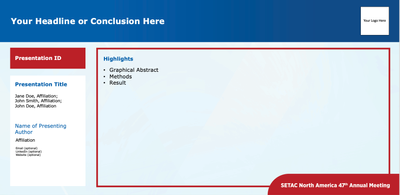
For your convenience and optional use, we will provide an easy-to-use 45.5×22.5-inch poster Powerpoint template for all presenters. (Please note, the presentation ID is your poster number, for example, 1.01.P-Mo001.)
If you use the poster template, please select a printer who will print at up to 200% of the original template size. The printed poster size will then be up to 91 inches x 45 inches to fit within the poster display. Do not print over 200% of the original template size as your poster will be too large to fit the poster display.
Poster Content Design
- Poster presentation could be innovative and it is suggested to prominently feature the conclusion in the title. Displaying the online/virtual presentation number is also advised.
- Poster should be understandable without oral explanations.
- Posters should be readable from five feet away.
- Posters should be clear and simple. When designing a poster, make an initial rough layout, keeping in mind the proportions of figures, tables, and text and try to maintain a balance of utilizing approximately 50% of the poster board area.
- Good posters should avoid being a short manuscript. Be clear and brief in all statements.
- Posters ideally have tables and figures displayed chronologically in vertical progression.
- Increase accessibility by using larger font sizes, keeping contrast high and considering color blindness, and embracing white space. For the virtual version of your poster, consider using alt text for images and providing labels for buttons.
- Posters should include acknowledgements and disclosures of obvious conflicts of interest (and those that may be perceived by the scientific community as such) as well as research funding or other sources of support.
- Presentations should not promote a commercial product, process or service nor denigrate (falsely accuse) the work or product of others.
In-Person Poster Display
Posters are displayed all day in the exhibit area. Poster sessions will be grouped by topic. Each poster display will be 7'7" x 3'9" (91 inches x 45 inches) mounted horizontally. This measurement fits within the metal frame border. All poster material should be confined to the space provided. The poster board surface consists of fabric over cork board. Push pins or Velcro can be used to mount the poster.
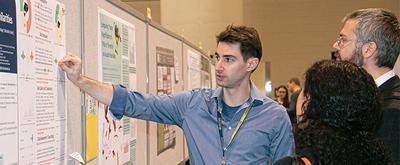
One author of each poster abstract is responsible for the proper assembly, mounting and presentation of the poster. Presenters can hang their poster starting around 8:00 a.m. the day of their presentation; posters must be hung by the start of the morning poster session. Poster viewing is throughout the day, and presenters are expected to attend their poster during the poster sessions. Posters must be removed immediately at the end of each day, so that the boards may be prepared for the next day. The poster board surface consists of fabric over cork board. Push pins or Velcro can be used to mount the poster. Volunteers will be present in the exhibit hall and available to provide assistance and answer any questions.
Please note presenters are responsible for printing their own posters. There are no on-site printing services at the venue. There is a Bureau en Gros (Staples) printing option near the convention center, located at 770 Rue Notre-Dame Ouest Montréal.
Setup: 8:00 (see map of the exhibit hall)
Take down: 17:30–17:45
Morning Poster Session: 9:15–10:00 Tuesday–Thursday
Afternoon Poster Session: 15:30–17:30 Tuesday–Thursday
In-Person Poster Presenter Responsibilities
In-person poster presentations will be displayed onsite and must also be uploaded to the virtual platform for online viewing; upload by 30 October. Presenters will receive poster board numbers and a link to upload (within the abstract management system) following the registration deadline. See instructions for virtual presentations.
Each poster presentation can only have one person listed as the presenter and that person must be registered for and attend the meeting. Presenters are expected to attend their poster during poster sessions to discuss their work with scientists visiting their poster. Should circumstances prevent you from making your presentation, you must arrange for a substitute to present your poster and you must notify SETAC ([email protected]).
In-Person Oral Platform (12-minute format; will be recorded)
In-Person Oral Platform
Platform presentations are 12-minute oral talks given with the aid of projected slides, followed by 3 minutes of Q&A.
Optional Presentation Template

For your convenience and optional use, we will provide an easy-to-use 1920x1080 pixel Powerpoint template for oral presenters.
Platform Presentation Content Design
- Platform presentations could be innovative and start with a “highlights slide” that features the title of the presentation, the presenter’s name and affiliation and main conclusion. Adding the main conclusion into a highlight slide is what makes it different from the traditional title slide.
- Slides should communicate ideas, not details.
- Slides should be legible from 30–50 feet away.
- Slides should be clear and simple. For example, a table in a published article is much too detailed for a slide presentation. A graph or photograph may better communicate your data. Minimize distracting animations.
- Create accessible content as you create your slides, such as standard, non-decorative fonts (e.g. arial), high foreground-to-background contrast with simple colors, keeping color blindness in mind.
- Our technology for onsite platform presentations (Podium) does not allow audio in the live slide shows. If you need audio with your slides, please inform SETAC in advance.
- Avoid using transitions on the first slide as they may cause issues with the Podium system.
- Presentations should include acknowledgements and disclosures of obvious (or potentially perceived) conflicts of interest, as well as research funding or other sources of support.
- Presentations should not promote a commercial product, process or service nor denigrate (falsely accuse) the work or product of others.
Platform Presentation Format
Platform presenters can use digital projection of a PowerPoint presentation. Slide orientation should be landscape 16:9 while 4:3 is also acceptable. English live transcription will be automatically enabled for on-demand platform presentations once posted for on-demand viewing.
Platform Presenter Responsibilities
- Presenters have two options to upload the PowerPoint file of slides:
- In advance: One of the most effective contributions to a presentation is being well-prepared! Upload your slides in advance of the meeting, which takes away any last-minute hassle.
- On-site: You can also upload your presentation by 17:00 ET the day before your session in the Speaker Ready Room. To do so, presenters should have a copy of their PowerPoint presentation on a USB stick or accessible online (e.g., email, Google Drive, Dropbox or One Drive) for download.
- Each platform presentation can only have one person listed as the presenter and that person must be registered for and attend the meeting.
During the Meeting
- Presentations uploaded in advance of the deadline will be downloaded onto the computer before the session starts. However, please bring a backup of your PowerPoint presentation to the meeting on a USB memory device.
- Arrive 20–30 minutes prior to the beginning of your session and introduce yourself to the session chairs. Provide appropriate information to the chairs for your introduction.
- The chair will remind you to stay on time. Please do not take longer than your allotted time.
- Should circumstances prevent you from making your presentation, you must arrange for a substitute to present your paper and you must notify SETAC ([email protected]).
Platform presentations, with the presenter’s agreement, will be recorded using the Confex Podium software, which will capture your voice, slides and cursor activity. Laptops in each session room will show a screen with all presentations of the upcoming sessions. Follow these guidelines to ensure your presentation is clear in the session room and in the recording:
- Click the button with your name and presentation a few seconds before you begin your presentation. This will launch your slides and start the recording.
- Use the microphone by the podium, otherwise the recording will not include your voice.
- Use the mouse to point instead of a laser pointer. By using the mouse, you will always be facing the audience and the microphone, and all mouse activity will be recorded for the virtual audience and on-demand viewing.
- Leave your last slide on the screen when you take questions to continue the recording.
- Repeat the question from the in-person audience. This way questions can also be heard by the virtual audience and in the recording.
- Exit from your slides after you are done taking questions to conclude the recording.
Virtual-Only (PDF, PDF with audio or video)
Virtual-Only Presentation
Virtual presentations can take the form of PDFs, videos (12 minutes or less) or enhanced posters (see below).
Presenters of virtual presentations or in-person poster presentations must upload PDFs, videos or e-posters associated with their presentation for the virtual component by the upload deadline; upload by 30 October. Presenters will receive poster board numbers and a link to upload (within the abstract management system) following the registration deadline. All virtual presentations are on-demand only and will not be presented live.
- Presentations will be organized within track and then by sessions, regardless of type (e.g., videos of slides, poster PDF or enhanced poster).
- Each presentation will have a textual Q&A chat box tied to it. This Q&A chat box will be available throughout the live meeting from 2–5 November and accessible for all attendees. Questions and answers can be captured at all times and will remain accessible during the live meeting and will be viewable for at least three months after the conference.
- Each presentation will be linked to a blinded email function (presenters’ email doesn’t show) so participants can email the presenter.
- PDF files of posters or slides are welcome and must be in landscape orientation.
- An aspect ratio of 16:9 is preferred while 4:3 is acceptable.
- The maximum file size is 200 MB.
- To keep file size low, export your files for online viewing instead of print when prompted. Your typical screen resolution is 72 dpi (print is 300 dpi).
- Poster files cannot contain embedded links
Video
- Accepted file formats include MP4, AVI, WMV and MOV
- Compress pictures to “on-screen” quality before saving.
- One of the easiest ways to create a recording of your presentations is through the PowerPoint recording tool. Check out this YouTube video for instructions.
- Presentations should include a voice-over or a video insert of presenter speaking.
- If you place a video of the presenter speaking, be sure to not place content on your presentation in that area.
- You can also use Skype, Zoom or any other recording technology.
- Any attached recording (video or audio) should NOT exceed 12 minutes. Shorter presentations are welcomed if they are deemed enough to convey the message.
- To make videos accessible to a larger audience, we strongly encourage you to include transcriptions or closed captions in your recorded presentation.
- Subtitles typically contain a transcription of the dialogue.
- Closed captions also describe audio cues such as music or sound effects that occur off-screen.
- Video description means audio-narrated descriptions of a video’s key visual elements. These descriptions are inserted into natural pauses in the program’s dialogue. Video description makes video more accessible to individuals who are legally blind or visually impaired.
Presentation Upload
- The presenting author will receive upload instructions from the SETAC office by email.
- At upload, presenters will have to grant permission to SETAC to allow presentations to be made available for a specified period of time.
Publications
- All accepted abstracts are published in the meeting abstract book under ISSN 1087-8939. SETAC retains the rights to all material published therein.
- If you are interested in publishing your work beyond the meeting, SETAC offers additional opportunities both before and after the meeting.
Session Chair Responsibilities
Session Chair Responsibilities
Sessions are developed in collaboration between sessions chairs and the program committee, who are required to adhere to all SETAC policies, including the Code of Ethics and Code of Conduct as well as Participants Policy. This is inclusive of SETAC’s Open Science and Confidentiality Policy and, as such, unpublished material in a submitted abstract is confidential and shall not be used or otherwise disseminated until published, and then with appropriate attribution as well.
To learn more about the types of sessions supported at the SETAC North America annual meeting, please review the session formats tab above.
Session Review
The scientific committee of the program committee reviews session proposals and will notify session chairs.
All tentatively accepted sessions are included in the call for abstracts though they are not guaranteed a session slot in the final program until final approval by the scientific subcommittee at the end of the abstract submission period, typically in June.
Session Planning
Once the scientific committee has accepted a session proposal, the responsibilities of the session chairs include:
- Solicit abstracts and specifically recruit for participation in the session.
- Review all submitted abstracts in the session.
- Provide recommendations to the scientific committee regarding the acceptance or rejection of each abstract and the best organization of the session in terms of flow of the presentations so they provide a well-rounded perspective on the topic.
Once the scientific committee has developed the program, the responsibilities of the session chairs include the following:
- Create an outline of an engaging session including discussion points for the live discussion
- Interact with presenters and make them feel welcome
- Chair the session and keep time
Session Proposal
November–February
- Chairs submit session proposals.
February–March
- Chairs will be notified about tentative acceptance of their session proposal. Some chairs may be asked to work with others and will have the opportunity to resubmit proposal.
March
- Abstract submission opens.
March–June
- Chairs recruit designated abstracts
- Chairs start reviewing abstracts submitted to their session and providing recommendations to the scientific committee.
June
- General call for abstracts closes.
- Session chairs provide recommendations to the scientific committee.
- Session chairs plan discussion points if they are including a discussion at the end of their sessions.
- The scientific committee reviews the submitted abstracts and prepares the meeting program.
July
- SETAC sends the results of the abstract review to the presenters.
- SETAC sends the results of the abstract review to the session chairs.
Once Sessions Are Accepted
July
- SETAC posts the program online.
- Late-breaking science abstract submission opens.
- For planned discussions, the chairs are encouraged to use discussion points to guide their conversation, they may display them on slides. They may choose to use the meeting slide template; however, it should only be used for this purpose and not to present personal research.
- If time slots have opened up in an oral session due to withdrawn presentations, the session chairs may fill that slot by asking a poster presenter to give an oral talk instead of a poster, planning a discussion session, or organizing a poster highlights session. The chairs will have access to contact poster presenters in their sessions after the program is published. If the chairs decide to plan a discussion, they should make sure they have prepared an outline and some discussion points. If they decide to organize a poster highlights session, then one of the chairs will need to compile 2-3 slides per poster into one power point presentation and upload it at the meeting so they can be accessed from the podium. The time slot could be referred to as poster highlights in the program if arranged in advance. It does not need to list the posters that will be highlighted. If a list of those is available well ahead of time, they might be listed in the print program or the online program. Regardless, the session will be linked in program to the poster session. Please keep us apprised of plans by emailing [email protected].
August
- Late-breaking science abstract submission closes.
September–October
- SETAC sends upload link to presenters so they can upload their presentations (for online viewing).
- Presenters prepare and submit presentations based on guidelines provided by SETAC.
- Session chairs monitor and carefully review abstracts to their sessions. If the session includes a discussion session, the chairs make sure they have prepared an outline for the discussion. If time slots have opened up in an oral session due to withdrawn presentations, the session chairs are encouraged to fill the time with a discussion or poster highlights (see above). They can also ask one poster presenter to give a talk in addition to their poster. Note that, depending on timing, it might not be feasible to alter the program at this time.
During the Meeting
Session chairs are expected to interact with presenters in all associated session (talks, posters, and virtual only) in their sessions and make them feel welcome and included.
In-person Platform Session (Talks)
In-person audience:
- One chair should be focused on the in-person audience
- The chair should display the pre-loaded Welcome slide a few minutes before start time.
- The chair should introduce the talks and keep time.
- For planned discussion time slots, the chairs are encouraged to use discussion points to guide their conversation, they may display them on slides. They may choose to use the meeting slide template; however, it should only be used for this purpose and not to present personal research.
- For planned poster highlights time slots, chairs are expected to have arranged those with poster presenters and to have compiled 2-3 slides per poster into one power point presentation that they would then access from the podium.
- The chair should handle questions from online audience while also making room for another chair to read questions form the virtual audience.
In-person Poster Session (Posters)
In-person audience:
- Presenters will put up their posters between 07:30 and 08:00. The posters are displayed all day in the exhibit area. The authors will receive instructions on where to put up their poster. Your presence as a session chair is not needed during the poster set-up.
- Visit the poster presenters during the break and poster socials: acknowledge your contributors and initiate a discussion if feasible.
- Poster presenters have also been asked to upload a pdf or e-version of their poster to the meeting platform, which remains available on demand until three months after the meeting.
Chairs are expected to enforce the SETAC Code of Conduct during both the in-person and online meeting.
Session Formats
Session Formats
The following list describes potential session formats at a SETAC meeting.
Poster Sessions
Poster sessions are made up of a group of presentations given with the aid of posters.
Traditional Poster Sessions
Poster presentations are selected and organized into sessions by the session chairs in collaboration with the program committee from abstracts submitted during the call for presentations. Posters should stand on their own, telling the research story without a verbal narrative. However, it is often helpful when presenters provide a short oral narrative of their work . Participants can engage in one-on-one Q&A with the presenters.
Platform Sessions
Traditional Platform Sessions
Traditional platform sessions are made up of a series of presentations given with the aid of slides. Presentations are selected and organized by the session chairs in collaboration with the program committee from abstracts submitted during the call for presentations. Participants can engage in Q&A with the presenters. Traditional sessions will occur as 120 minute blocks that can include six 12-minute talks, followed by 3 minutes for Q&A and 5 minutes for transition. Some traditional platform sessions may reserve the last slot for a moderated conversation based on a few discussion points to allow for an overarching dialogue about the topic. In that case, chairs are asked to submit an abstract for the discussion slot with high level discussion points.
Special Sessions
Special sessions need to be organized well in advance of the meeting and in full collaboration with the meeting program committee and the SETAC office to be successful. These sessions can be composed of invited and solicited abstracts. Typically, only a few such sessions are organized at the meeting. Individuals proposing a special session should include a description of the format requested, and if applicable, list topics and speakers that will be invited and any other pertinent details. Special session can be 1 or 2 hours in length. These sessions take more preparatory work on the part of the session organizers; however, they are often rewarding to all participants and make for a diverse and stimulating program.
Special session chairs may propose to invite keynote speakers to their session. Keynote speakers bring value to meeting participants but would not typically be expected at a SETAC meeting as they might not fit the typical SETAC member profile. SETAC North America would provide keynote speakers complementary meeting registration and might add a small honorarium and travel stipend, as needed. The Board of Directors reviews keynote speaker proposals on a rolling basis between the call for sessions and two weeks after the call for abstracts to allow the board time to review and more importantly to allow the chairs time to plan their sessions well.
If you have any ideas of special session formats you would like to pursue or would like to propose a keynote speaker for your special session, please contact [email protected] to discuss.
A few examples of various special session formats are presented below.
View sample special session.
SETAC Forum
SETAC forums have a slightly flexible format. This type of format is helpful to demonstrate tools or heavily engage with the audience. It is useful where strict timing between speakers might be an impediment to advancing the topic.
SETAC Debate Session
SETAC debate sessions have been highly successful in past meetings. The session organizers carefully select three to five guests to debate a hot topic with assistance of a moderator (could be a session organizer). The session organizers ensure that various aspects or stances on the topic are represented to allow for a thorough debate. The guests come prepared to defend their stance while the moderator is prepared to keep the debate going by making pointed provocative statements. SETAC debates are typically quite thought provoking. They are often lively and great for public commentary on contentious issues that are relevant to the SETAC audience. The moderator and debaters are, of course, expected to adhere to common courtesy and the SETAC code of conduct. Debate sessions lend themselves very well to controversial topics.
SETAC Panel Discussion Session
Panel discussions are a great way to get more than one expert opinion on a topic in a short amount of time. The goal of the discussions is to present an overarching perspective and summarize the state of the science on the topic. The session organizers carefully select three to five guests to present about and discuss a specific topic with the assistance of a moderator (could be a session organizer). Panels are much more open and interactive than traditional presentations, and debates and audience participation is highly encouraged. Panel discussions are a great option to discuss timely topics and new approaches.
SETAC Storytelling Session
Storytelling is an engaging presentation style that is gaining popularity. The presentation “stories” can be the typical length of a traditional platform presentation delivered as a story and followed by a short Q&A period. The storytelling format is an excellent choice for sessions focused on case studies (e.g., session focused on green chemistry, LCA, remediation, restoration, ecosystem services and sustainability).
SETAC Campfire Session
Campfire sessions are a cross between the storytelling sessions and panel discussions. A short story is told and followed with extensive discussion. The goal is to allow the attendees to generate the majority of the discussion and knowledge sharing. The storyteller becomes the facilitator. Attendees get to participate, learn, listen to multiple perspectives on the same issue, and share experiences with others. Campfire sessions could be a good format for case studies where the presenters identify several alternatives or challenges and want input from the audience on solutions. This could be a good fit for sessions focused on development of methods, models, technologies, etc.
SETAC Wave Session
Inspired by Pecha Kucha and Ignite, this is a rapid presentation style where speakers have a short amount of time to present a limited number of slides that have a minimum text font size or maximum number of words per slide. This presentations style allows speakers to give a big picture overview of a subject in a short amount of time thus providing “a wave” of information that quickly washes over the audience. For example, this format could suggest presentations follow a 6-12-24 rule (6 slides, 12 minutes, 24 font/words per slide). Session organizers may want to work with presenters ahead of the meeting to insure they are interpreting requirements well and that the session will be a success.
Virtual Only Sessions
Presentations in virtual-only sessions can take the form of PDFs, videos (12 minutes or less) or enhanced posters. These presentations must be submitted prior to the meeting start date and will be accessible online to all meeting participants on-demand (i.e., will not be associated with a set date or time). Participants can interact with presenters via asynchronous chat.
Session Guidelines
Session Guidelines
Sessions are developed in collaboration between sessions chairs and the program committee, who are required to adhere to all SETAC policies, including the Code of Ethics and Code of Conduct as well as Participants Policy. This is inclusive of SETAC’s Open Science and Confidentiality Policy and, as such, unpublished material in a submitted abstract is confidential and shall not be used or otherwise disseminated until published, and then with appropriate attribution as well.
To learn more about the types of sessions supported at the SETAC North America annual meeting, please review the session formats tab above.
Session Submission
Guidelines
- Format:
- Title: Please use title case and spell out abbreviations and acronyms. There is a limit of 150 characters (including spaces) for the title of the session.
- Description: Do not exceed 2,500 characters (including spaces and references). Keep abbreviations and acronyms to a minimum and be clear and concise.
- Session chairs: Please list a minimum of two and a maximum of four session chairs. SETAC strongly encourages sector diversity and please consider including students and early career researchers as co-chairs.
- Please submit all communications in English, the official language of SETAC North America.
- If the proposal is submitted by a SETAC Interest Group, this should be indicated during submission
A minimum of two chairs and a maximum of four chairs should accompany every session submission.
Session Review
The scientific committee of the program committee reviews session proposals and will notify session chairs.
All tentatively accepted sessions are included in the call for abstracts though they are not guaranteed a session slot in the final program until final approval by the scientific subcommittee at the end of the abstract submission period, typically in June.
Session Planning
Once the scientific committee has accepted a session proposal, the responsibilities of the session chairs include:
- Solicit abstracts and specifically recruit for participation in the session.
- Review all submitted abstracts in the session.
- Provide recommendations to the scientific committee regarding the acceptance or rejection of each abstract and the best organization of the session in terms of flow of the presentations so they provide a well-rounded perspective on the topic.
Once the scientific committee has developed the program, the responsibilities of the session chairs include the following:
- Create an outline of an engaging session including discussion points for the live discussion
- Interact with presenters and make them feel welcome
- Chair the session and keep time
Session Proposal
December–February
- Chairs submit session proposals.
February–March
- Chairs will be notified about tentative acceptance of their session proposal. Some chairs may be asked to work with others and will have the opportunity to resubmit proposal.
March
- Abstract submission opens.
March–May
- Chairs recruit designated abstracts
- Chairs start reviewing abstracts submitted to their session and providing recommendations to the scientific committee.
May
- General call for abstracts closes.
- Session chairs provide recommendations to the scientific committee.
- Session chairs plan discussion points if they are including a discussion at the end of their sessions.
- The scientific committee reviews the submitted abstracts and prepares the meeting program.
June
- SETAC sends the results of the abstract review to the presenters.
- SETAC sends the results of the abstract review to the session chairs.
Once Sessions Are Accepted
June–July
- SETAC posts the program online.
- Late-breaking science abstract submission opens.
- For planned discussions, the chairs are encouraged to use discussion points to guide their conversation, they may display them on slides. They may choose to use the meeting slide template; however, it should only be used for this purpose and not to present personal research.
- If time slots have opened up in an oral session due to withdrawn presentations, the session chairs may fill that slot by asking a poster presenter to give an oral talk instead of a poster, planning a discussion session, or organizing a poster highlights session. The chairs will have access to contact poster presenters in their sessions after the program is published. If the chairs decide to plan a discussion, they should make sure they have prepared an outline and some discussion points. If they decide to organize a poster highlights session, then one of the chairs will need to compile 2-3 slides per poster into one power point presentation and upload it at the meeting so they can be accessed from the podium. The time slot could be referred to as poster highlights in the program if arranged in advance. It does not need to list the posters that will be highlighted. If a list of those is available well ahead of time, they might be listed in the print program or the online program. Regardless, the session will be linked in program to the poster session. Please keep us apprised of plans by emailing [email protected].
August
- Late-breaking science abstract submission closes.
September–October
- SETAC sends upload link to presenters so they can upload their presentations (for online viewing).
- Presenters prepare and submit presentations based on guidelines provided by SETAC.
- Session chairs monitor and carefully review abstracts to their sessions. If the session includes a discussion session, the chairs make sure they have prepared an outline for the discussion. If time slots have opened up in an oral session due to withdrawn presentations, the session chairs are encouraged to fill the time with a discussion or poster highlights (see above). They can also ask one poster presenter to give a talk in addition to their poster. Note that, depending on timing, it might not be feasible to alter the program at this time.
During the Meeting
Session chairs are expected to interact with presenters in all associated session (talks, posters, and virtual only) in their sessions and make them feel welcome and included.
In-person Platform Session (Talks)
In-person audience:
- One chair should be focused on the in-person audience
- The chair should display the pre-loaded Welcome slide a few minutes before start time.
- The chair should introduce the talks and keep time.
- For planned discussion time slots, the chairs are encouraged to use discussion points to guide their conversation, they may display them on slides. They may choose to use the meeting slide template; however, it should only be used for this purpose and not to present personal research.
- For planned poster highlights time slots, chairs are expected to have arranged those with poster presenters and to have compiled 2-3 slides per poster into one power point presentation that they would then access from the podium.
- The chair should handle questions from online audience while also making room for another chair to read questions form the virtual audience.
In-person Poster Session (Posters)
In-person audience:
- Presenters will put up their posters between 07:30 and 08:00. The posters are displayed all day in the exhibit area. The authors will receive instructions on where to put up their poster. Your presence as a session chair is not needed during the poster set-up.
- Visit the poster presenters during the break and poster socials: acknowledge your contributors and initiate a discussion if feasible.
- Poster presenters have also been asked to upload a pdf or e-version of their poster to the meeting platform, which remains available on demand until three months after the meeting.
Chairs are expected to enforce the SETAC Code of Conduct during both the in-person and online meeting.