
Are Your Measured Chemicals Data Reliable and Relevant for Your Intended Purpose?
Not Sure? You Need CREED.
Graham Merrington and Iain Wilson, wca environment; and Adam Ryan, IZA
What Is CREED?
Criteria for Reporting and Evaluating Exposure Datasets (CREED) is a practical and technically robust way to evaluate whether exposure datasets are fit for a specified assessment purpose. The approach was developed at a SETAC Technical Workshop in 2022.
These criteria provide guidance on study characteristics to be reported so that practitioners can make informed use of their datasets. This is not a wholly new concept, as schemes to evaluate the reliability and relevance of ecotoxicity data, including CRED (Criteria for Reporting and Evaluating Ecotoxicity Data), have long been in place, often in regulatory protocol documents.
Want to Apply CREED to Your Data? Sign up for the half-day professional training course at the SETAC North America 47th Annual Meeting, held from 2–5 November in Montreal, Canada.
The developers of the CREED publications recognized that there were few means to evaluate the reliability and relevance of measurements of chemicals in the environment (exposure data). They also recognized that not all exposure data are appropriate for all the purposes for which they may be used. As we all know, how exposure data are selected can have a great bearing on the outcomes of an environmental assessment and, subsequently, the conclusions drawn, decisions taken and resulting allocation of finite resources.
CREED was developed so that data generators and assessment practitioners who utilize the exposure data of others, from publications and data repositories, will be able to ensure that their data and the data they use are fit for their intended purpose. CREED provides improved transparency, auditability and confidence in the assessment.
Why CREED?
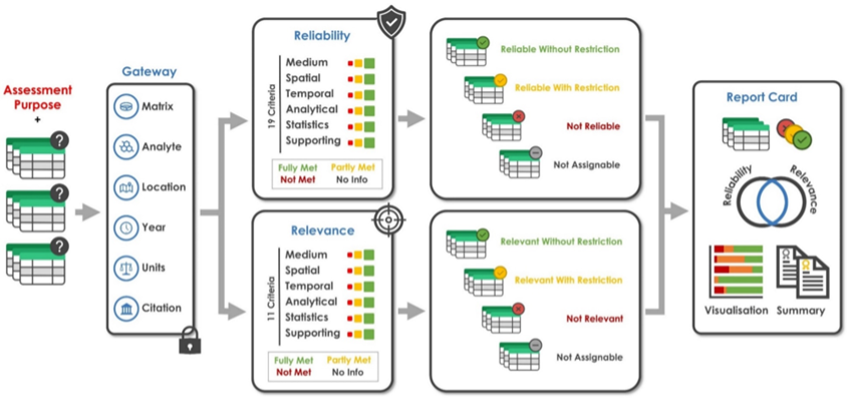
The CREED approach provides a framework for using best practices to evaluate the reliability and relevance of measured data, provides a minimum-level requirement (Gateway criteria) for all data and enables users to define the purpose for which they wish to use their data. Importantly, the structure of CREED means that reliability and relevance are assessed separately, but a report card is presented on completion that provides clarity on where information is missing or if there are gaps. For data generators, the approach provides clear guidance on reporting requirements to ensure that data are likely to be reliable and relevant for a purpose, before they are generated. You can read the articles published from the CREED workshop and view webinar recordings on the SETAC Science page dedicated to Data Usability.
In Europe, there are indications that regulatory data generators and database custodians, such as the European Environment Agency (for WISE 6), are considering adopting aspects of CREED that will facilitate exposure data evaluations.
How Can You Use CREED?
CREED was developed by people from industry, academia, regulatory agencies and consultants who recognized the importance of making sure the approach was accessible to technical “nonexperts,” and so is usable by scientific generalists. As such, CREED has an intuitive Excel-based sheet to guide users through the approach.
To help those interested, a professional training course is being offered at SETAC North America 47th Annual Meeting, which will be held from 2–5 November in Montreal, Canada. This course will guide participants through the CREED approach, highlighting best practices and providing an opportunity to apply CREED to evaluate their own datasets for their own purposes.
If you are interested, please sign up for the half-day course. If you cannot make it but want to learn more, contact the authors.
Author contacts: [email protected], [email protected] and [email protected]