Advancing the Science of Species Surrogacy
Toward Mechanistically Informed, Data-Integrated Cross-Species Extrapolation
Katie Coady and Claudia Rivetti, Meeting Chairs
We’re excited to invite you to the upcoming SETAC topical meeting on Advanced Approaches for Species Surrogacy in Chemical Risk Assessment Topical Meeting, to be held 1–2 November in Montreal, Canada, ahead of the SETAC North America 47th Annual Meeting.
Species surrogacy – the use of selected organisms to represent a broader range of species – has long been a cornerstone of environmental risk assessment. Yet, despite its widespread application, it often relies on pragmatic safety factors or conservative precautionary approaches that lack grounding in mechanistic, exposure or ecological information.
Today, that paradigm is rapidly evolving. Advances in toxicology, comparative biology, computational modeling and data science, together with the growing availability of curated databases and bioinformatics tools, are opening new opportunities to strengthen the scientific foundations of cross‑species extrapolation. These developments, rooted in New Approach Methodologies (NAMs), have the potential to move the field toward more transparent, robust and predictive frameworks for decision‑making.
This topical meeting will bring together scientists from academia, business and regulatory organizations to examine how these advances can be translated into practice. The aim is not only to review the current state of the science but to critically explore where uncertainty remains and how multiple lines of evidence can be combined to reduce it.
We plan to review recent advances in NAMs and examine how these approaches can support chemical risk assessment, enable regulatory decision-making and reduce reliance on vertebrate animals in testing.
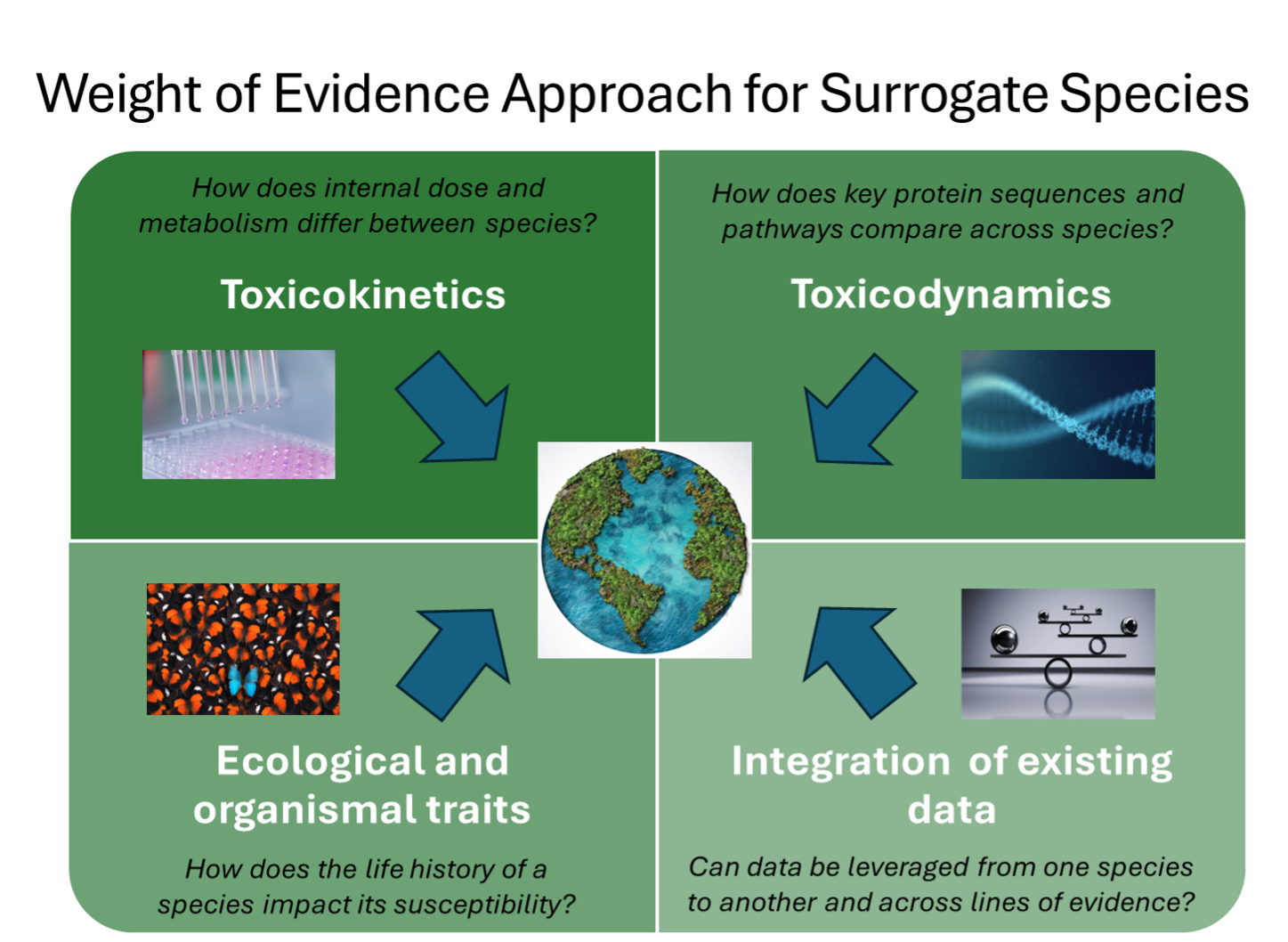
The program is structured around four interconnected scientific themes:
1. Toxicokinetics. This session will explore how interspecies differences in absorption, distribution, metabolism and excretion shape chemical sensitivity and can be leveraged in qIVIVE-PBK modeling, with an emphasis on biotransformation across species.
2. Toxicodynamics. This session will examine how conservation of biological targets and pathways can be used to inform susceptibility across taxa with an emphasis on bioinformatics tools.
3. Species Traits and Functional Diversity. This session will examine how ecological and physiological traits can drive species and ecosystem vulnerability and resilience to chemical stressors.
4. Leveraging Existing Toxicity Data. This session will focus on case studies that illustrate how to integrate datasets and lines of evidence to improve predictions for untested species.
Key objectives of the meeting include:
- Review the current state of tools, methods and data for cross‑species extrapolation including humans
- Identify key areas of uncertainty in regulatory and research contexts
- Advance weight‑of‑evidence approaches for data integration
- Highlight critical scientific data gaps limiting broader adoption of approaches
- Foster collaboration across scientists, risk assessors, and regulators
- Define priorities for future activities, including potential technical workshops and publications
Planned as a two-day, in-person event, the meeting program will feature plenary sessions introducing each scientific theme, invited and contributed oral presentations, poster sessions highlighting emerging methods and examples, and interactive discussions linking science to regulatory application.
The meeting is expected to attract a broad, multidisciplinary audience, with relevance for ecological and human health risk assessors, regulators, academic and industry scientists, tool developers and animal welfare organizations. Overall, the meeting is set to deliver far-reaching impacts by pinpointing best practices and critical knowledge gaps, strengthening the bridge between cutting-edge research and regulatory requirements, and generating influential conference outputs and publications while also charting the course for future initiatives. Authors will be sought from the meeting participants.
If you’d like to participate and present your work in this area, please note that the call for abstracts is open until 28 July. Registration for the meeting will open in mid-July.
The meeting is being organized by a multi‑sector steering committee co‑chaired by Katherine Coady, Bayer CropScience, and Claudia Rivetti, Unilever. Representing academia, government, business and nonprofit organizations, the committee is working closely with SETAC staff to develop the scientific program, foster collaboration across sectors and guide discussions on future research and regulatory priorities. A full list of steering committee members is available on the meeting website.
This meeting offers a timely opportunity for the SETAC community to collectively advance one of the field’s most foundational concepts, redefining species surrogacy for a new era of mechanistically informed, data‑integrated risk assessment and recognizing species differences not as a barrier but as a source of predictive insight.
For more information, visit www.setac.org/surrogates.
We hope to see you there!
Authors contact: [email protected] and [email protected]