
Strengthening Environmental Collaboration in Southeast Asia: SETAC Asia-Pacific at ICEPORM 2026
Zuzanna Neziri, Executive Director SETAC Asia-Pacific
SETAC Asia-Pacific recently co-organized the 5th International Conference on Environmental Pollution, Restoration and Management, or ICEPORM, held at the International Center for Interdisciplinary Science and Education in Quy Nhon, Vietnam, bringing together scientists, environmental managers and policymakers from across the region and beyond.
The meeting, held from 9–12 March, welcomed nearly 90 delegates from 22 countries, representing universities, research institutes, businesses and government agencies. Co-organized by Rencontres du Vietnam and ICISE in collaboration with SETAC Asia-Pacific, Auburn University, and the Vietnam Academy of Science and Technology, the conference highlighted the growing importance of Southeast Asia as a focal point for environmental science, collaboration and capacity building.
ICEPORM, first established in Vietnam in 2010, aims to connect scientists and environmental managers to address pressing environmental challenges, share knowledge and promote collaboration toward sustainable development. This mission was reflected in a comprehensive scientific program featuring nearly 90 presentations across plenary, parallel and poster sessions.
The program covered a broad range of topics, including integrated environmental pollution, environmental toxicology, public health, environmental risk assessment, treatment and restoration technologies, and environmental management and policy. Microplastic pollution and its impacts on natural ecosystems emerged as a key theme, with particular relevance to Southeast Asia and broader Asia-Pacific region.
SETAC Leadership and Plenary Contributions
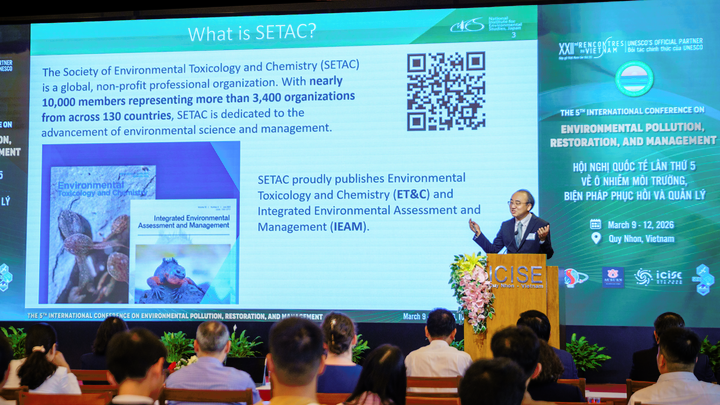
SETAC Asia-Pacific played a prominent role in the conference program through its leadership and scientific contributions. SETAC Asia-Pacific President Hiroshi Yamamoto delivered a plenary presentation on emerging environmental contaminants and chaired key sessions, helping guide the scientific direction of the meeting.
SETAC Asia-Pacific board member Charles C.C. Lee also delivered a plenary presentation focused on deforestation challenges and sustainability in the context of COP30, bringing a strong regional and policy-relevant perspective.
In addition, Associate Professor Sean Norman of the University of South Carolina delivered a plenary presentation on wastewater resistomes in Vietnam, highlighting the intersection of environmental science, public health and data-driven approaches to understanding antibiotic resistance.
Together, these plenary contributions reflected the breadth of scientific challenges being addressed — from chemical pollution and ecosystem impacts to infrastructure, health and large-scale environmental change — and reinforced the importance of interdisciplinary and collaborative approaches.
Science Leadership and Emerging Risks
During the conference, Yamamoto also engaged with Vietnamese media, emphasising that science must play a leading role in identifying emerging environmental threats and guiding effective responses.
He highlighted climate change, environmental pollution and biodiversity loss as three of the most pressing challenges facing the Asia-Pacific region, noting that these pressures are intensified by rapid urbanization, industrialization and population growth.
Yamamoto further underscored the growing importance of so-called “invisible pollutants,” including micro-pollutants, chemical mixtures and emerging contaminants such as PFAS. Many of these substances remain insufficiently characterized, despite contributing significantly to environmental risk, highlighting the need for more integrated and forward-looking scientific approaches that consider both known substances and their alternatives.
Connecting Science, Policy and Practice
ICEPORM provided a strong platform for collaboration across academia, government and business, reflecting SETAC’s multidisciplinary approach. In addition to the scientific program, working sessions were held with Vietnamese environmental regulatory agencies, alongside meetings in Hanoi with the Vietnam Academy of Science and Technology and government stakeholders.
These engagements focused on strengthening long-term collaboration, supporting capacity building and expanding opportunities for Vietnamese scientists to engage with international research networks.
The conference also included short-term training programs for Vietnamese and international graduate students and early-career researchers. Courses on environmental risk assessment and microplastics analysis in water were delivered ahead of the formal program, helping build technical capacity and supporting the next generation of environmental scientists.
Regional Relevance and Future Direction
Southeast Asia continues to face increasing environmental pressures driven by rapid economic growth, urbanization and industrialization. Discussions at ICEPORM emphasized that environmental challenges are complex and require integrated, science-based solutions supported by collaboration across sectors.
SETAC Asia-Pacific’s involvement reflects its broader commitment to supporting environmental science across the region, particularly in areas where knowledge exchange, training and collaboration can deliver meaningful impact.
Looking Ahead
Building on the momentum from ICEPORM and the Hanoi meetings, SETAC Asia-Pacific will continue to strengthen engagement in Vietnam and across Southeast Asia through partnerships focused on scientific exchange, training and regional collaboration.
This growing engagement also contributes to the lead-up to the SETAC Asia-Pacific 15th Biennial Meeting in Tsukuba, Japan, in 2026, where continued collaboration across the region will be further advanced.