SETAC Contributes to Advancing Science-Based Innovations for the SSbD Concept
Annegaaike Leopold, Calidris Environment BV; Michelle Bloor, University of Glasgow; Ksenia Groh, Eawag; Leo Posthuma, RIVM; Hans Sanderson, Aarhus University; Hanna Schreiber,Environment Agency Austria; Christopher Schür, Eawag; and Paul Thomas, KREATiS SAS
At the third Safe and Sustainable by Design (SSbD) boot camp, organized by the Joint Research Centre (JRC) of the European Commission (EC), in Ispra, Italy, we were honored to present the recommendations and research gaps that were identified during the SETAC – EC consultation series held in 2023 and 2024. This consultation series, aimed at identifying opportunities and research topics that, once addressed, will improve the scientific underpinning and applicability of the SSbD framework. Organized by the Sounding Board to support SETAC Europe’s membership of the High-Level Round Table (HLRT), these consultations received input from more than 100 SETAC scientists. We extend our sincere thanks to all who contributed. Our poster, presenting the synthesis of this input at the SSbD bootcamp, drew attention from representatives of the Joint Research Centre (JRC), the Directorate-General for Research and Innovation (DG RTD) and the Directorate-General for Environment (DG ENV), as well as industry representatives, consultants and academics present at the bootcamp.
Background and Context
SETAC Europe has been tracking the evolving landscape of European chemicals regulations closely and aims to contribute to its scientific underpinning. This effort began with SETAC Europe’s membership of the HLRT for the implementation of the Chemicals Strategy for Sustainability (CSS) under the Green Deal (see related SETAC Globe articles from 2021 and 2023).
The HLRT brought together representatives from industry, academia, NGO’s and EU member states who served as ambassadors for the CSS. During four meetings, held in 2021 (two), 2022 and 2023, the HLRT developed recommendations on better implementation, specifically in areas related to enforcement and compliance. It also provided opportunity for crucial dialogue between stakeholders, helping address implementation challenges. Specifically, this allowed us to make our scientific voice heard and to establish a collaboration with DG RTD as well as JRC in order to create a dialogue between SETAC members involved in (aspects of) the SSbD framework and the individuals in the EC leading this development.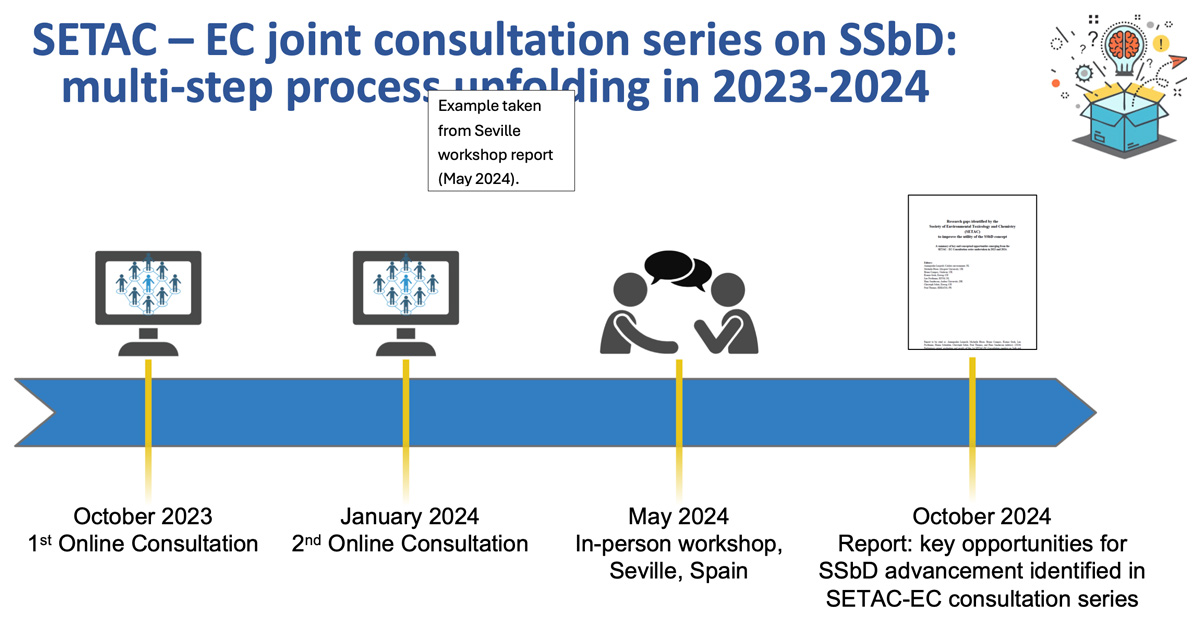
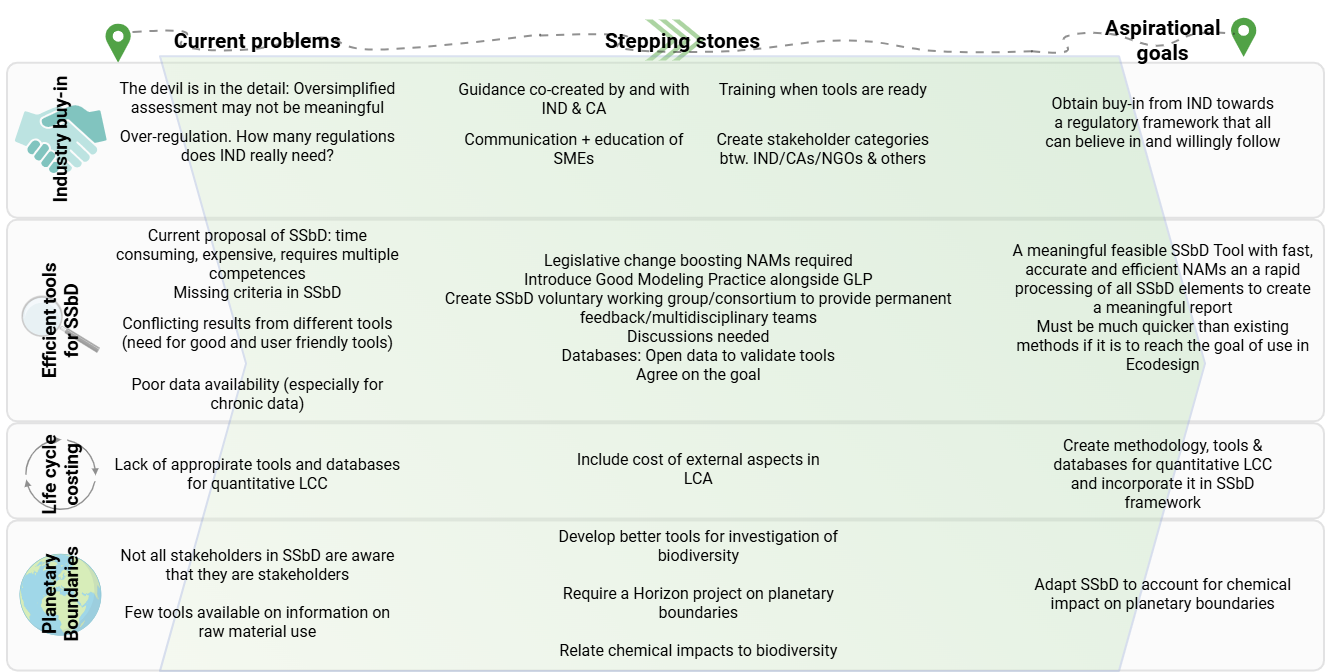
A series of consultations was held between October 2023 and May 2024 to engage the SETAC community. Two were held online and one in-person during the SETAC Europe 34th Annual Meeting in Seville, Spain. As described in a letter to the editor published in Integrated Environmental Assessment and Management by Leopold and coauthors, the consultations followed a step-wise approach. Detailed reports are available for the October 2023, January 2024 and May 2024 meetings. During the first meeting, formatted as a SETAC-Café, participants contributed science-based ideas for improving the SSbD framework, which organizers compiled into a list. From these ideas, priorities were selected for a second meeting, which expanded on them through a provisional roadmapping activity using the same format. We would like to acknowledge Joakim Jeppson, who coached the Sounding Board on a technique of roadmapping developed by the Institute for Manufacturing, University of Cambrige. In the final meeting – an in-person workshop – six different break-out groups each worked on more detailed roadmaps, formulating aspirational goals. These goals were then connected to specific challenges in present reality, and steppingstones were identified to bridge the gap from challenges to aspirational goal. An example of such a roadmap is given below:
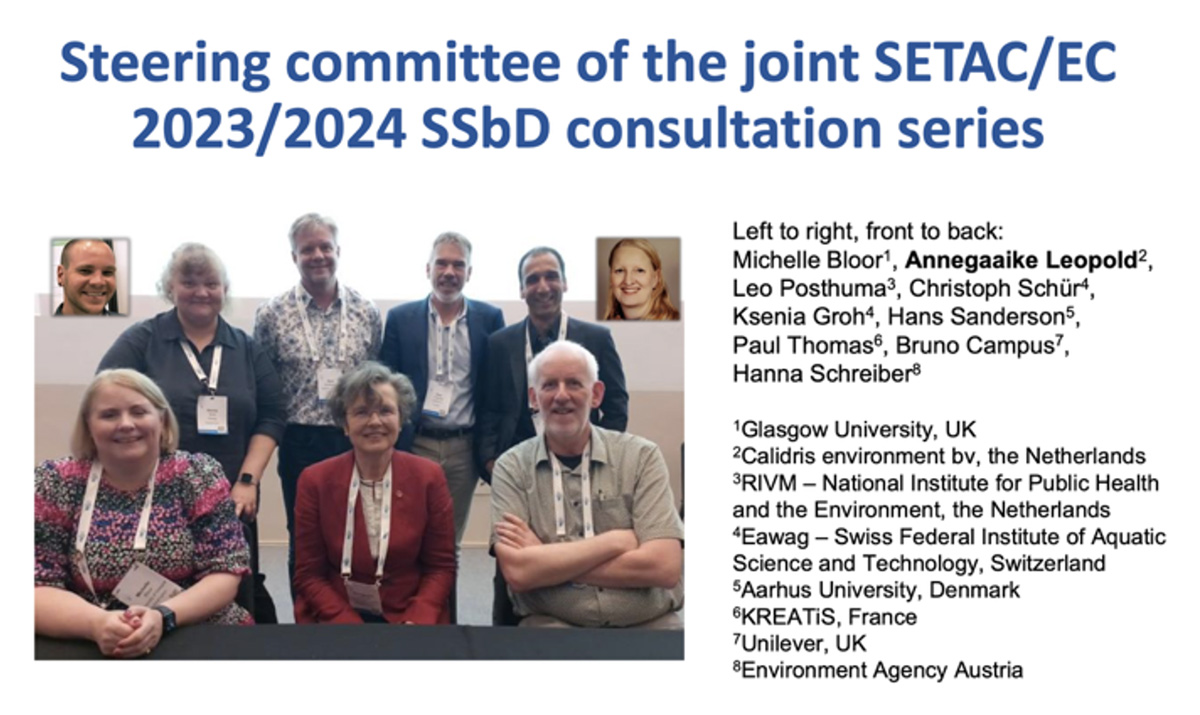
Following the Seville workshop, conceptual recommendations and research gaps were extracted and formulated by the Steering Committee, which consisted of the members of the sounding board, originally established to support SETAC Europe’s membership of the HLRT, with two additional members.
While the overall recommendations and research gaps identified as outcome of the consultation series focused on the environmental aspects (E) and did not touch on social (S) and governance (G) aspects – which require separate expert analysis in these fields – one of the research gaps identified was the need to develop a better understanding of socioeconomic factors that influence reciprocal interactions between chemicals and people.
A full overview of the recommendations and research gaps is provided in the letter to the editor mentioned above. A related article, also published in IEAM identifies the SSbD approach as a potential Green Swan (recall the keynote speech by John Elkington at the SETAC Europe annual meeting in Vienna in May).
In parallel to the HLRT meeting participation and the subsequent consultation series discussed above, a series of special sessions on different aspects of the CSS were held during SETAC Europe annual meetings between 2020 and 2025. Discussions ranged from how to prioritize investment efforts to achieve safe and sustainable chemicals to questions about how SETAC can facilitate and achieve the collaborations needed to develop multidisciplinary and transdisciplinary solutions. For example, participants emphasized the need for both high-throughput hazard screening using New Approach Methodologies (NAMs) and more holistic, spatially and temporally resolved analyses to evaluate the effects of chemical mixtures in the environment. At the most recent SETAC Europe 35th Annual Meeting in May, the topic “leveraging AI power to advance biodiversity protection” was the main theme of the special session.
A further expression of SETAC Europe’s involvement in providing scientific input to shape a safe and sustainable future for chemicals was the inclusiong of these topic in the theme of the SETAC Europe 35th Annual Meeting, “Innovation for Tomorrow: Progress in Safe and Sustainable Concepts.”
Looking Ahead
In order to solidify the scientific contributions to SSbD and beyond, we will communicate with the different DG’s in EC and EU member countries, as well as specific funding agencies, to promote the uptake of the research gaps and recommendations we have identified into research programs in Europe and beyond. SETAC Europe is planning to expand and nurture its relationship with the EC into the future, to provide scientific input to policies such as the CSS and the Green Deal more broadly. As we reiterate how much we appreciated the contributions of the more than 100 SETAC members who attended some or all of the consultation meetings, we would like to encourage all SETAC members to further engage with us. In the coming months, we will share opportunities to get involved.
Contact: [email protected]