SETAC at 45 Years Old
Tamar Schlekat, SETAC
A diverse group of SETAC members—representing different environmental science disciplines, geographic units, sectors and career stages—came together around SETAC’s 45th anniversary for a series of discussions spanning more than 18 months. These conversations resulted in “A Critical Perspective on the Society of Environmental Toxicology and Chemistry’s Adherence to Founding Principles – Opportunities for the Future” recently published in SETAC’s Journal Environmental Toxicology and Chemistry.
The article begins by tracing SETAC’s origins, from its founding in 1979 in the United States to its evolution into a global scientific society. It then examines SETAC’s founding mission and principles before outlining how those have been restated in recent years. Currently, SETAC’s mission is to “advance environmental science and management” and the Society’s guiding principles are multidisciplinary approaches, multisectoral engagement and scientific objectivity.
The authors review both opportunities and challenges associated with adhering to these principles at SETAC‘s 45th anniversary. They suggest that insufficient, excessive or poorly structured multidisciplinary work can lead to negative outcomes when addressing highly complex environmental challenges. While SETAC has traditionally been regarded as an organization focused on environmental chemistry and ecotoxicology, the authors note that its scope has expanded toward a more holistic “One Health” approach. To fully realize its potential as a leader in both ecological and human health, they suggest that SETAC must continue to strengthen cross-disciplinary collaboration, particularly for environmental problems that require transdisciplinary solutions. The article highlights the wide range of disciplines that must work together to achieve meaningful progress on environmental issues – an approach that aligns with SETAC positioning itself as the global home for environmental professionals.
With respect to multisectoral engagement, the authors identify this principle as one of SETAC’s greatest strengths, reflected in Society policies for technical committees, including Pellston Workshop® steering groups. At the same time, they acknowledge the challenge of achieving balanced sector representation in meeting sessions. This is particularly an issue in newer SETAC Geographic Units such as Africa and Latin America, where participation is predominantly academic. While SETAC has sought to mitigate this imbalance – for example, by inviting business and government representatives to special symposia held in conjunction with meetings – a more systematic approach may be worthwhile.
Finally, the authors address the principle of scientific objectivity, noting that scientific objectivity is a remarkably difficult concept. Simply, it is basing belief on evidence and logic, but it can also be defined as the absence of bias.” They note that campaigns of misinformation and disinformation increasingly challenge scientific credibility, making objectivity more essential—and more demanding—than ever. Scientists, they argue, must present evidence-based conclusions while clearly acknowledging uncertainty.
Overall, the article provides a series of thought-provoking observations and recommendations for SETAC’s future growth and development, summarized in Table 1.
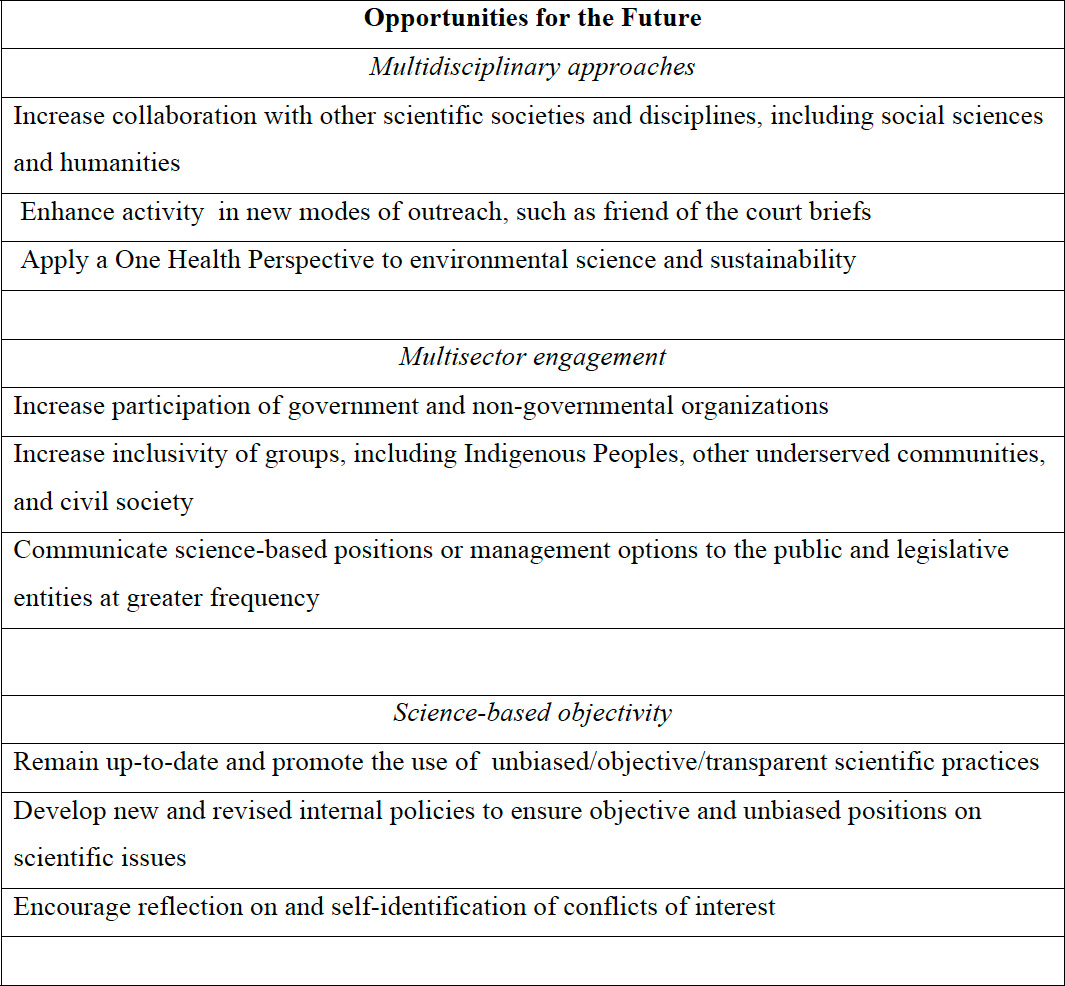
Together, these reflections offer the Society both a candid assessment and an inspiring roadmap. As summarized in Table 1, the authors present a series of thoughtful recommendations that underscore the Society’s capacity to evolve while remaining true to its core values. SETAC has already begun advancing many of these efforts, yet the paper reminds us that sustaining scientific excellence, fostering broad collaboration, and championing objectivity will require continued commitment. As SETAC marks its 45th year, the article ultimately serves as an invitation—to reflect, adapt and reaffirm the Society’s long-standing dedication to strengthening environmental science for the benefit of both ecosystems and human health.
Contact: [email protected]