
PFAS in Our Food: From Farms and Fields to Streams and Shores
Oindrila Ghosh, University of Pittsburgh; Jonathan Petali, Battelle; Erin L. Pulster, U.S. Geological Survey; and Christopher J. McCarthy, Jacobs
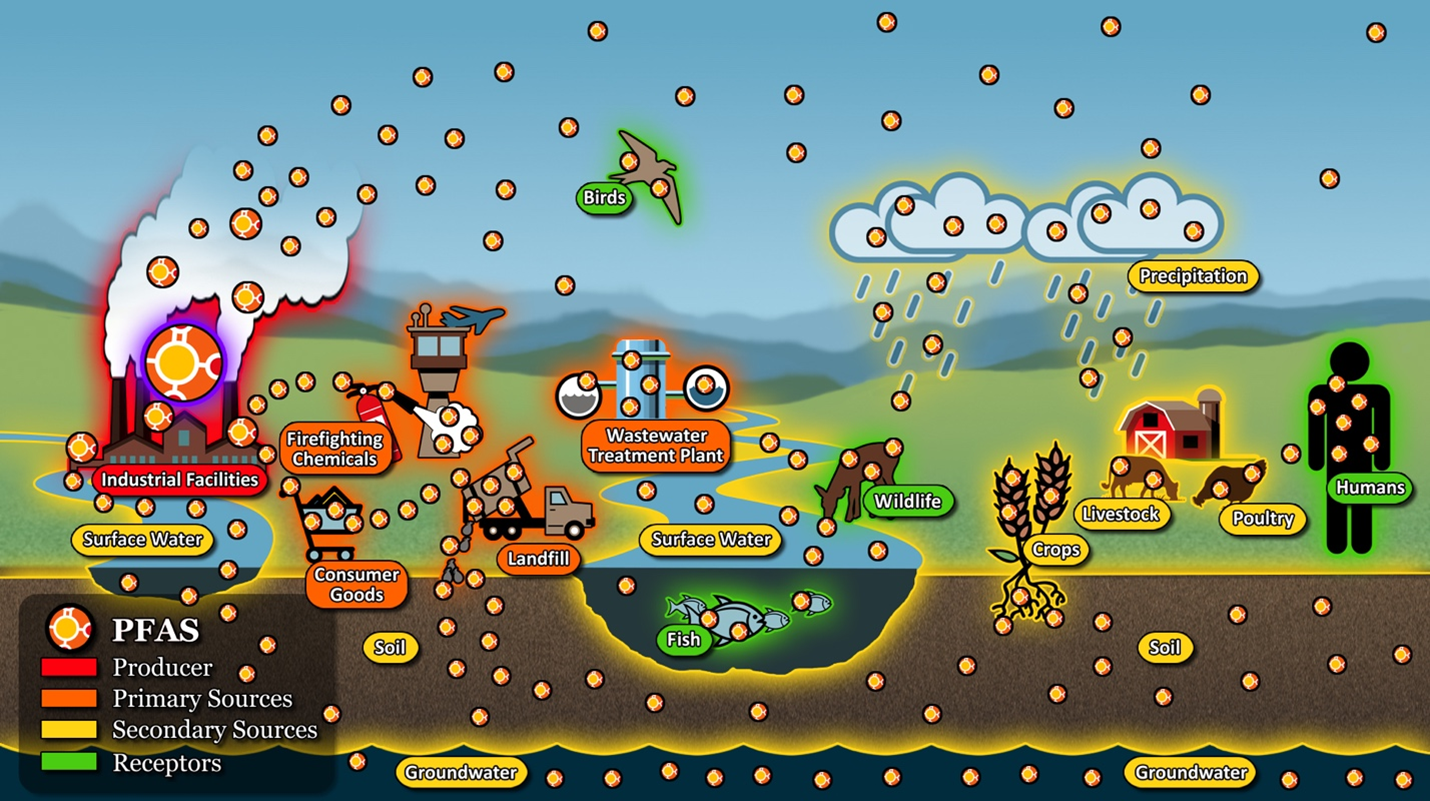
Environmental transport pathways of PFAS, demonstrating the routes by which these substances enter the food supply—specifically via contaminated water, agricultural crops and animal products. Adapted from a 2024 U.S. Geological Survey report.
The concern of per- and polyfluoroalkyl substances (PFAS) contamination has historically focused on drinking water, but communities and researchers are increasingly realizing that drinking water may not be the only important exposure pathway. PFAS move through surface water, sediments and soils into groundwater, wildlife and even our agricultural systems. Consequently, they affect the foods that shape daily life, cultural traditions and community health. Research on dietary PFAS exposure has typically been confined to fish consumption despite the potential for broader impacts given the widespread occurrence of PFAS in the environment.
To address critical knowledge gaps, the session “Per- and Polyfluoroalkyl Substances (PFAS) in Our Food: From Farms and Fields to Streams and Shores” brought diverse perspectives to the participants of the SETAC North America 46th Annual Meeting, held in November 2025 in Portland, Oregon. Chaired and organized by this article’s co-authors, the session convened academic researchers, consultants, regulators and public-health practitioners working across water, soil, agriculture and fisheries. The overarching goals were to connect environmental monitoring with real-world dietary exposures, to move the conversation toward actionable solutions to PFAS pollution, and to fill the knowledge gap on PFAS in food sources. Three broad and interconnected themes of PFAS in food were revealed from this session: mobility through aquatic food webs, accumulation in agricultural and livestock systems, and impacts on home-raised foods and community food security. This article follows those thematic threads, emphasizing how different lines of research can collectively illuminate one of the most complex challenges in environmental health today.
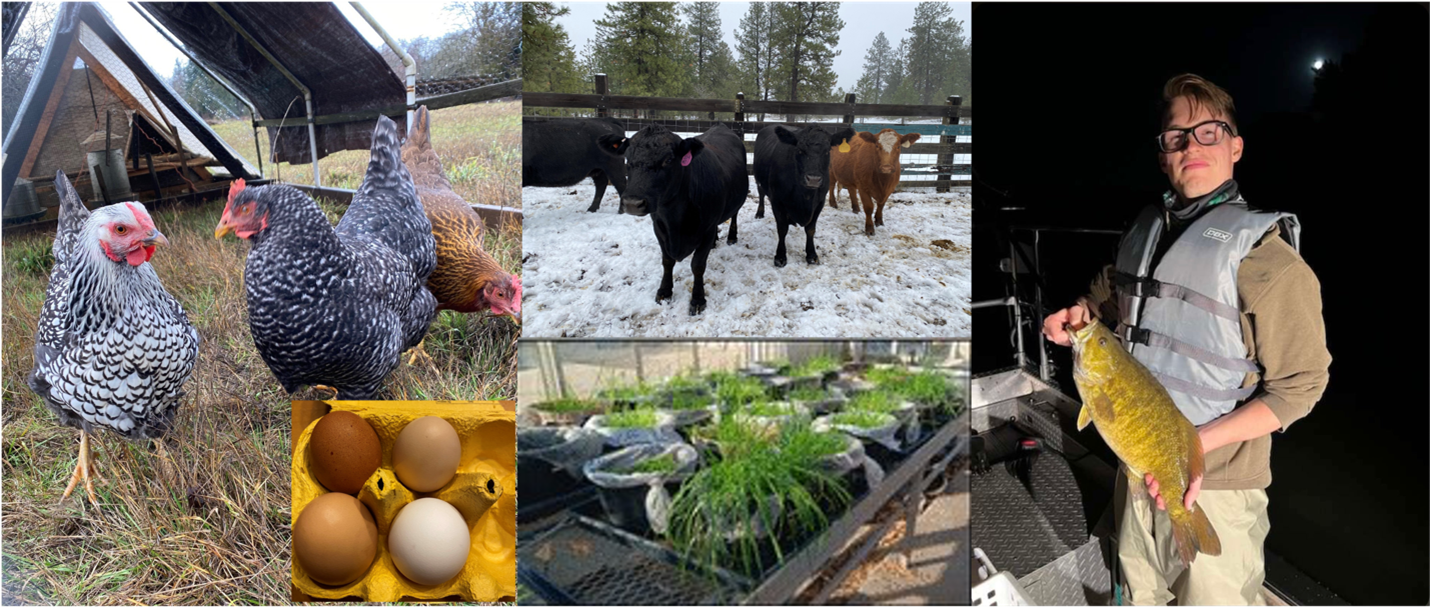
Images from session presentations illustrating PFAS impacts across agricultural and aquatic systems. Farm photo by Barbara Morrissey; greenhouse grasses by Openiyi et al., 2025; fish photo by Eric Levanduski.
Farms and Fields
Growing interest in investigating the impacts of PFAS on the diverse array of agricultural products continues in both home-grown and commercial operations. This session was dominated by presentations characterizing uptake, bioaccumulation and exposure estimates of legacy (i.e., PFOA and PFOS) and novel PFAS.
A major theme of the session involved PFAS mobility in plants, revealing patterns linking PFAS-specific chemical structure and environmental conditions to biological uptake. Evaluating 10 legacy and replacement PFAS in hydroponically grown tomatoes, Rebecca Yates, University of California, Riverside, presented that in several cases, replacement PFAS (i.e., GenX and ADONA) accumulated more readily in fruits than PFOA, while leaf tissues showed even higher concentrations across all compounds compared to fruit. Similarly, Ariana Lazo, Purdue University, found tissue-specific differences in uptake and compartmentalization of PFAS into grain and fiber by evaluating soybeans and hemp grown in soils from PFAS contaminated fields. Soybean leaves consistently contained the highest PFAS levels, especially in high-yield varieties. Hemp results suggested that fiber-oriented cultivation could mitigate human dietary exposure, contingent upon the tissue-specific partitioning of ingested PFAS. Across both crops, results indicated that agricultural decision-making, including crop type, cultivation strategy and variety selection can significantly modify PFAS risk profiles on contaminated land. Accumulation was driven by structural features, which may enhance mobility along the transpiration stream, suggesting PFAS-specific chemistry may be an increasingly important consideration when characterizing uptake.
While evaluating plant uptake of contaminants can be challenging, other presenters explored increasingly more complex questions by investigating how field conditions and soil properties affect PFAS uptake. Elijah Ojo Openiyi, Purdue University, rpesented research examining whether wood ash could be used as a soil amendment to mitigate PFAS uptake, thereby addressing the risk of exposure to grasses and livestock. While greenhouse studies showed clear reductions in PFAS uptake by grasses, a two-year field study using the same soils revealed substantial discrepancies. In uncontrolled environments shaped by weather, soil heterogeneity and atmospheric deposition, the mitigation effect weakened. Results highlighted the risk that successful mitigation achieved in controlled laboratory conditions does not guarantee equivalent performance under naturally occurring conditions.
The session featured studies on plant and animal protein uptake of PFAS, including livestock and animal products. Barbara Morrissey, Washington Department of Health, presented research how they responded to community concerns by analyzing PFAS in home-raised eggs, meats and poultry from two rural communities. Researchers from Washington state analyzed more than 70 food samples and provided personalized consumption guidance to most participating households. The power of this work lay in its analytical rigor and its successful community engagement model. The collaboration involved direct family engagement, retesting foods after animals were switched to PFAS-free water, and explaining the differential persistence of PFAS across eggs, poultry and livestock. Similarly, Christopher J McCarthy, Jacobs, presented a detailed evaluation of livestock fed fodder grown with PFAS-contaminated irrigation water, bridged agricultural science and risk assessment. They estimated human exposure (adults and children) by integrating measured PFAS in feed with toxicokinetic models predicting levels in meat and milk. While the site risk was low, the process revealed broader challenges: there are few PFAS-specific benchmarks for soils, feeds or livestock products, requiring risk assessors to creatively adapt existing frameworks. This signals a growing benefit for guidance aligned with real-world agricultural practices for farmers, veterinarians and land managers.
Streams and Shores
The meeting was rich with several technical sessions, presentations and posters on the presence of PFAS in surface waters, their bioaccumulation potential and impacts to aquatic species. Highlighted research of this session emphasized the significance of exposure pathways and risk assessment.
Md Saiful Islam, Temple University, presented research in the Delaware and Schuylkill Rivers quantifying temporal changes in PFAS signatures across multiple reaches. Their findings highlighted widespread PFAS presence, with composition patterns that shifted with proximity to population centers and industrial corridors. A particularly compelling observation was the temporal evolution of PFAS mixtures. The Delaware River transitioned from predominantly long-chain PFAS in 2019 to increased proportions of short-chain and replacement compounds by 2021. Results were dynamic contaminant profiles, an important consideration for monitoring programs tracking seasonal and yearly changes in PFAS occurrence.
With regard to freshwater fish, there was keen interest not only in characterizing occurrence but understanding bioaccumulation related to supporting monitoring and regulatory efforts. Eric Levanduski, SUNY College of Environmental Science and Forestry, has continued his work with collaborators to develop a robust understanding of species-specific PFAS bioaccumulation in freshwater fish collected from regional streams. Leveraging an existing dataset encompassing over 2,500 individuals across 53 freshwater species from New York state, their work underscored that PFAS challenge historical paradigms that assumes bioaccumulation follows predictable relationships to body size or lipid content, like other legacy contaminants. They found that PFAS accumulation in freshwater species was specific to species and life-history characteristics through the application of Bayesian mixed-effects models to control the confounding influence of site contamination. The findings provide practical guidance for monitoring programs that can provide information in which species can best represent aquatic-life exposure.
The third contribution that focused on the aquatic food web was presented by Frannie Nilsen, North Carolina Department of Environmental Quality. She presented research how they examined PFAS in 14 recreationally harvested fish species from the Cape Fear River in North Carolina. Analyzing more than 250 fish fillets for 56 PFAS, their dataset is now instrumental in calculating statewide bioaccumulation factors, water-quality standards development, and fish consumption advisories. The findings emphasized that community fish consumption surveys are crucial for optimizing study design and accurately capturing regional dietary PFAS exposures.
Looking Ahead
The technical session concluded with a presentation that underscored the importance of re-evaluating existing data from a high-level perspective to address fundamental, big picture questions. Naiba Allahverdiyeva, Jacobs Engineering Group Inc, gave a virtual presentation on PFAS in Germany’s food supply, offering a view of European efforts to understand dietary exposure. While drawing from European Food Safety Authority (EFSA) reports, market-basket surveys and case studies such as PFAS in wild boar, the talk illustrated how PFAS contamination intersects with modern food processing, agricultural soils, groundwater and livestock drinking water. Notably, several exposure estimates reached EFSA’s dietary thresholds associated with immune system impacts, a reminder that the dietary health risk posed by PFAS in food supplies is a global concern alongside the existing regulatory and public pressures for drinking water protections.
As the session drew to a close, participants reflected on the broader implications. PFAS in food systems is no longer a hypothetical scenario; it is a tangible problem facing anglers, commercial and non-commercial farmers, home gardeners and families dependent on private wells. The discussion emphasized the need for the testing of compost, home garden soils, animal feed and irrigation water, as well as bioavailability-informed models that better connect environmental concentrations to health outcomes. Many attendees noted that communities today are active co-creators of research agendas, having moved beyond their traditional role as passive recipients of scientific findings. Several studies demonstrated that community members influenced the scientific questions by articulating the specific knowledge required to feel safe feeding their families. A recurring insight was that mitigation must occur upstream in the supply chain, preventing PFAS from entering food webs in the first place rather than relying on downstream corrective actions after harm has occurred.
Aligned with the meeting’s theme, “The Essence of Science: Curiosity, Discovery and Solutions,” the session demonstrated that curiosity is driving researchers to investigate PFAS in new ecological and agricultural spaces, discovering the mechanisms and pathways that govern food-system contamination. While solutions remain a future goal, they will require cooperation across the diverse expertise represented by SETAC’s membership and network of collaborative professionals.
Contact: [email protected]