
Mapping the Future of Bioaccumulation Science
Outcomes From the Bioaccumulation Science Interest Group Meeting
Marco Franco, Swiss Federal Institute of Aquatic Science and Technology (Eawag); Leslie Saunders, Concawe; and Markus Brinkmann, University of Saskatchewan
The Bioaccumulation Science Interest Group (BSIG) convened its annual business meeting at the SETAC Europe 36th Annual Meeting in Maastricht, the Netherlands, bringing together an engaged community of researchers, regulators, consultants and industry professionals. Discussions were informed by both a global online survey and an interactive Mentimeter poll, offering a comprehensive view of current priorities and future directions in bioaccumulation science.
Overall, the results point to a shared ambition to advance predictive, harmonized and non-animal approaches, while addressing persistent challenges around data quality, methodological complexity and regulatory alignment. A summary of the survey and poll results can be found on the BSIG SETAC Groups website.
Insights from a Community Survey and Meeting Poll
The meeting opened with a review of the global survey results and an interactive poll with meeting participants. Poll participants reported experience working across an exceptionally wide range of chemical domains, including nanomaterials, PFAS, pesticides, pharmaceuticals, metals, polymers, surfactants and UVCBs. Experience also spans a broad spectrum of B-related activities, from research and regulation to data evaluation, standard testing, method development and new approach methodologies (NAMs). This breadth of expertise highlights BSIG’s role as a key forum for cross‑sector dialogue and collaboration.
Apart from community engagement, one of the central questions posed in the survey asked participants what bioaccumulation assessment should aim to achieve. Many emphasized the need for science‑based protection of ecosystems and human health, using terms such as “protecting wildlife,” “protecting the food chain,” “ecosystem protection” and “environmental safety.” Others highlighted the importance of standardization and harmonization, with repeated references to advancing NAMs. Indeed, a strong theme across responses was the desire to reduce animal testing, reflected in phrases like “reduce animal testing,” “avoidance of fish” and “animal‑free predictions.” Participants also called for improved predictive tools, better data quality and more transparent assessment frameworks.
Participants were also asked to identify the biggest challenges facing bioaccumulation science, with consistent themes emerging across both the online survey and the in‑room poll. Data quality and availability were frequently cited, alongside lack of harmonization and regulatory clarity across geographic regions. A prominent theme was the disconnect between scientific advances and regulatory frameworks, reflecting challenges in translating research into practice and policy. Methodological complexity was also highlighted, with references to difficult‑to‑test compounds and limited model organisms with relevance to different ecosystems. Collectively, these challenges highlight the need for coordinated, international efforts and closer alignment between bioaccumulation science and policy.
Taken together, the responses reflect a community striving for a more predictive, harmonized and transparent approach to bioaccumulation assessment, increasingly supported by non‑animal approaches. Addressing the identified challenges will be critical to this vision.
Translating Insights Into Action
The poll concluded with a discussion of whether a focused bioaccumulation workshop is needed, and the response from the community was clear. Nearly all respondents indicated that such a workshop would be valuable, with the majority describing it as an immediate need. Participants emphasized the importance of involving regulators, aligning bioaccumulation protection goals and addressing methodological gaps. Many expressed a desire for case‑study‑focused sessions, methods‑oriented content and NAM‑focused training. The idea of developing a “Science-Regulation Roadmap” emerged as a central theme, reflecting the community’s desire for a coordinated effort to bridge bioaccumulation science and regulation.
In addition to the workshop, several priority activities were identified for BSIG. These include developing regular webinars or newsletter-style updates to increase engagement and share research, as well as preparing a focus article similar to the one published by Lillicrap and colleagues in 2016 to highlight key advances in bioaccumulation science. Participants also suggested opportunities to strengthen visibility at SETAC meetings through more targeted sessions and coordinated promotion of relevant content, along with exploring training courses to support capacity building. There was strong support for a dedicated bioaccumulation workshop to address science-policy gaps.
Latest Developments – Business Meeting Presentations
The BSIG business meeting featured a series of short presentations highlighting ongoing work in the field. Adam Lillicrap, NIVA, opened the session with an overview of recent UK Environment Agency work on Daphnia, focusing on efforts to refine aquatic testing approaches and improve regulatory relevance. Heike Laue, Givaudan, then provided an update from the ECHA in vitro–in vivo extrapolation (IVIVE) Working Group, outlining progress toward integrating IVIVE into regulatory bioaccumulation assessment. Her presentation highlighted the capacity of IVIVE approaches for reducing reliance on vertebrate (fish) testing and improving mechanistic understanding, while also acknowledging the challenges associated with validation, standardization and regulatory acceptance.
Kehinde Olajide, Eawag, followed with a presentation on cellular systems for bioaccumulation science, emphasizing how cell-based models can provide mechanistic insights into uptake, distribution and biotransformation. His work illustrated the potential for fish cell lines as alternative testing approaches. Markus Brinkmann, University of Saskatchewan and co-chair of the BSIG, shared updates on avian bioaccumulation research, demonstrating how new models and species can extend in vitro biotransformation methods (e.g., OECD 319a/b) beyond traditional aquatic organisms. His presentation highlighted the importance of understanding dietary exposure pathways and species‑specific traits in predicting bioaccumulation in birds.
Jon Arnot, Arnot Research and Consulting, provided a perspective on ongoing modeling and data integration efforts, including improvements to predictive tools and databases. His update emphasized the need for transparent, high‑quality data and the importance of integrating multiple lines of evidence into weight‑of‑evidence frameworks. Finally, Michelle Embry, HESI, offered an update on HESI’s bioaccumulation initiatives, including collaborative projects aimed at harmonizing methods and supporting regulatory acceptance of new approaches. Her presentation underscored the value of multi‑stakeholder collaboration in advancing the field. The range of topics presented demonstrates the richness of the field and has motivated BSIG to organize a special B‑themed session at an upcoming SETAC meeting. Information will follow within the BSIG community to identify peers to lead such initiatives.
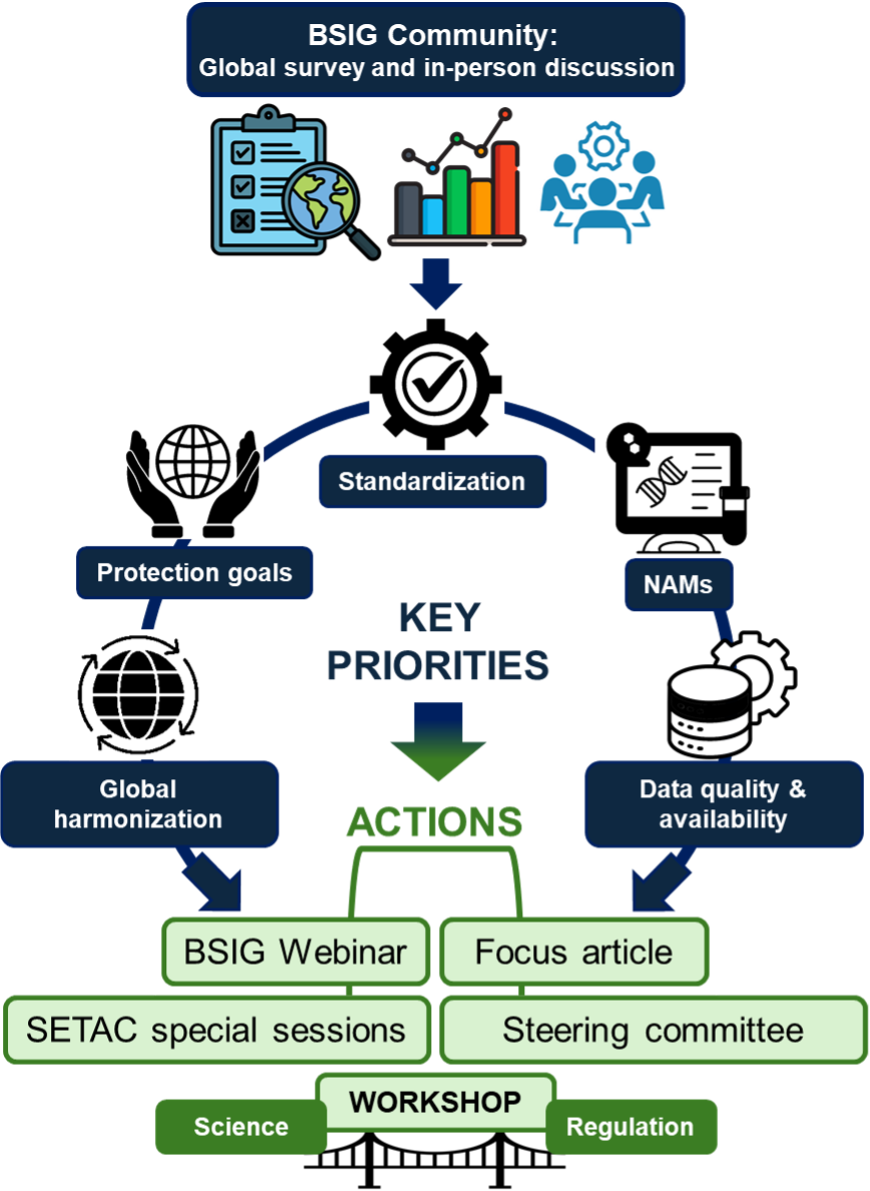
Figure 1. BSIG priorities and planned actions emerging from the community business meeting, highlighting collaborative efforts to advance bioaccumulation science.
Next Steps for BSIG
Taken together, the survey results, scientific presentations and in‑room discussions paint a picture of a field at a pivotal moment (Fig. 1). The bioaccumulation community is diverse, highly engaged and eager to collaborate on the next generation of bioaccumulation assessment tools and frameworks. At the same time, the challenges facing the field, including clarity about protection goals, data quality and availability, harmonization, methodological complexity and the integration of NAMs, are substantial and require international action. This underscores the need for coordinated participation and collaboration across regions. Building upon the momentum from Maastricht, the group hopes to expand training and capacity‑building activities, strengthen global representation and connect bioaccumulation science and policy in a coordinated and globally harmonized way.
To further increase avenues for engagement within the bioaccumulation community, the BSIG is opening nominations for steering committee positions, both for general members and co‑chairs. We also wish to strengthen participation from regions outside Europe and North America to ensure broader representation with some of the proposed initiatives above.
Author contacts: [email protected], [email protected] and [email protected]