From Going Online to Coming Home: 20 Years of the SETAC Europe Student Advisory Council
Markus Schmitz and Andreas Eriksson
It was six years ago, in mid-March 2020, that the COVID pandemic was declared; an event that changed the world forever and set us all on a journey we had to endure. For us on the SETAC Europe Student Advisory Council (SAC), the impact was felt at multiple levels, both in our day-to-day lives as PhD students and scientists in training, but also in how the council operated. The planned SETAC Young Environmental Scientists (YES) meeting in Aachen in 2021 was still a year away, and we suddenly had to ask ourselves a question that none of us had expected to face: How do you build a student community when people cannot meet in person?
Looking back, the years from 2018 to early 2020 were marked by momentum and a sense of possibility. The SAC saw a leadership transition: first from Katharina Hayes to Mafalda Castro, and then to Andreas Eriksson, who stepped into the Vice Chair role in 2020. At the same time, the YES meeting was growing rapidly: the 2019 meeting in Ghent brought together well over 120 students and became a reference point for what the community could be when the format worked. In that pre-pandemic phase, SAC activities were largely oriented toward opportunity: career development, networking and strengthening the student voice within SETAC Europe. Mental health was on our radar, and we hosted workshops and conversations on the topic, but it was not yet the dominant theme it would later become (we are environmental scientists and not psychologists). Even then, the long-term ambition was already taking shape, to move from just “being heard” to “being structurally represented,” including the early push (initiated by Mafalda) to establish a student seat with real influence.
Back to the planned YES 2021 meeting: early on during the pandemic, we postponed a final decision on going virtual until we could learn from SETAC’s first fully digital annual meeting in 2020. In the meantime, we planned in parallel, one path for “maybe in person,” one for “definitely online.” By late spring 2020, the direction was clear: we would host a digital YES meeting, and we would try to do it properly. We added a dedicated social platform (GatherTown, which was later picked up for SETAC Europe SciCon in 2021) and, for its time, it worked: the meeting attracted more than 100 attendees and felt surprisingly human, despite the distance. About six months later, the SAC could finally meet face-to-face again in Landau. And right there, with the relief of seeing people in the same room still fresh, we began planning the first Global YES meeting (March 2022). By the time that meeting took place, digital fatigue had set in. Even though YES 2022 ran globally, around the clock for 2.5 days, the social forum was nearly empty, and many participants appeared only for their own presentations. The message was clear, everyone wanted to return to in-person conferences.
In hindsight, the pandemic did more than disrupt logistics. It accelerated a shift in what students needed from their community. Workshops and career talks began to shift from the classic questions, such as “What career can I pursue?”, “How do I become the best scientist?” and “How do I get there?” toward something more fundamental: “How do I navigate this field?” and “How do I stay resilient and healthy while doing so?” For many early-career scientists, biodiversity loss, pollution and global changes are not abstract considerations but the very topics we work to understand every day. This is both motivating and daunting. One response we observed was a broadening of networks: the line between student and early-career blurred, and the SAC increasingly explored connections beyond SETAC governance circles toward a wider community of peers and mentors.
Not everything was doom and gloom during the pandemic years. Structurally, SETAC had for a long time encouraged and facilitated a stronger student voice, initially by granting the SAC observer status at SETAC Europe Council meetings. In 2020, Andreas was elected as the first student representative to the council (academic sector), and in the following year, the SAC was granted a permanent seat at the Council, which was filled by Markus. This was not a sudden change but the cumulative outcome of many SAC boards over more than a decade, supported, financially and politically, by SETAC Europe. In parallel, SETAC’s Business Model Review took place, with Markus contributing a student perspective. Parts of that work continue to shape SETAC today, including governance adjustments, leadership structures at SETAC Global, and changes to the membership structure.
Having adapted quite naturally to online and hybrid formats, just as you would expect from a generation that grew up digitally, we also learned what screens cannot convey. Inspiration is easier to spark when you share the same air, empathy travels faster when you can read a face without lag and poor resolution, and energy becomes something you feel rather than something you schedule. The SETAC Europe 32nd Annual Meeting in Copenhagen was one of the first truly on-site meetings again, and it is hard to describe without sounding exaggerated that it felt like a collective back to life, an almost biochemical rush of oxytocin and serotonin after two years of distance. For both of us, it remains one of the most intense conference experiences so far in the best sense. The following year, the meeting in Dublin brought back a similar warmth, but it also mirrored how quickly the world had started moving again; more than once we heard friends and colleagues say that this meeting felt more demanding and “loaded” than conferences before 2020.
And then came Landau, the first in-person SETAC YES meeting in Europe since 2019, celebrating the relief that the student community is strongest when it can actually meet. It was a return to a new baseline, in more than one way, returning to the place associated with the very first YES meeting many years ago. After everything we had tried to make work online, Landau reminded us why these gatherings, i.e., our annual meetings, YES meetings and our face-to-face meetings, are essential for SAC to function.
The SAC of today is not the same as it was before the pandemic, nor is it the same as it was during those years. We adapt to changing circumstances. One issue that has followed the SAC for a long time, however, is structural: the duration of service compared with the duration of actually being a student doesn’t match up. Until recently, the standard pathway meant serving two years as an elected member, followed by one year as Vice Chair, two years as Chair and one year as the “retired” Outgoing Chair, a total of six years. Most PhD students complete and defend their thesis in less time than that. In 2024, the Chair term was therefore reduced to one year. The underlying challenge has not disappeared, but it has become more manageable, especially when candidates join early in their PhD. At the same time, the SAC has continued to broaden its scope and look outward for new connections. During the SETAC Europe 34th Annual Meeting in Vienna in 2025, we hosted a joint special session with the junior groups of ASPIS and PARC, an initiative that reflected a broader development we have been observing for some time now: the line between student status and early-career stage is becoming increasingly blurred. As uncertainty grows, so does the need for practical skills, not only in building a career but in navigating it and maintaining resilience along the way. A similar development could be seen at the national branch level: with support from the SETAC Europe Council, former SAC member Sophie Oster and Markus Schmitz helped initiate a student seat on the SETAC German Language Branch Council, strengthening the direct connection to the wider membership base and creating another avenue for student and early-career engagement.
Building the “sandwich topping” across these three pieces, we are proud to say that SAC has maintained its core responsibilities: supporting students as they step into the world of environmental sciences. Most importantly, the SAC creates opportunities and enables networking among peers, friends and colleagues who share a nerdy passion for our environment. Writing this anniversary article also offers a useful throwback and a clear reminder of how global changes are reflected in our past and current engagement with and for students. And SAC without in-person meetings would hardly be possible, and a PhD without a network of peers would, in our experience, be far lonelier and less fulfilling.
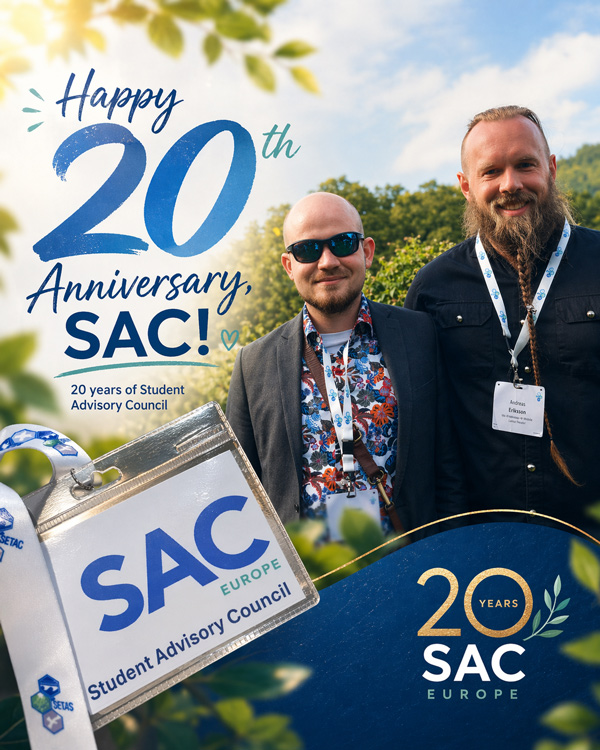
Header image: Frederik Meyer, Markus Schmitz and Andreas Eriksson infront of vineyards in Landau during the SETAC YES meeting, August 2025.
Authors contact: [email protected] and [email protected]