A Structured and Adaptive Approach to Defining Science Priorities for SETAC North America
Adam C. Ryan, International Zinc Association; Thomas G. Bean, BASF; Adriana C. Bejarano, University of Glasgow; Jonathan Challis, Agriculture and Agri-Food Canada; Rebecca L. Dalton, Environment and Climate Change Canada; Jon Doering, Louisiana State University; Justin Dubiel, University of Lethbridge; Markus Hecker, University of Saskatchewan; Shawn L. Sager, Arcadis; Jeffery Steevens, U.S. Geological Survey; Scott Lynn, U.S. Environmental Protection Agency
How should a scientific society define its priorities as environmental challenges, scientific tools and decision-making needs continue to evolve?
In 2024, the SETAC North America Science Committee (SC) set out to address this question through a structured, transparent and adaptable process. The goal was not to produce a fixed or exhaustive list of topics but rather to develop a guiding framework that reflects current and emerging scientific priorities – recognizing that priorities will evolve with new environmental challenges and advancements in the field. This effort is intended to support the SETAC North America Board of Directors and broader membership in identifying and developing strategic scientific directions aligned with the Society’s mission. For SETAC members, this framework offers a transparent way to understand how emerging science topics may influence future SETAC activities, including meeting themes, focused topic meetings, workshops, professional training courses, interest group activities and identification of strategic research initiatives.
Importantly, this analysis represents a snapshot in time (2024–2025); however, environmental science, regulatory priorities and technological capabilities continually evolve and are influenced by environmental and geopolitical events. Therefore, the framework was designed as a structured foundation for an iterative and adaptive process that can be used to identify, evaluate and refine scientific priorities over time.
Structured and Transparent Methodology
To capture a broad range of perspectives, the SC compiled an initial list of more than 90 potential scientific topics from multiple sources:
- Input from SC members – collectively representing academia, government and business
- Themes reflected in recent SETAC journal publications
- Perspectives from industry representatives
- Strategic priorities from government agencies in the United States and Canada
While each source contributed useful context, the most actionable insights emerged from SC member input and government priorities, which formed the primary basis for further analysis. As noted above, the SC itself reflects representation across academia, government and business, ensuring that multiple perspectives were incorporated into this process.
To synthesize priorities from this diverse set of topics, the SC translated them into a system of keywords using a hybrid approach. First, Microsoft Copilot® was used to group topics and suggest up to four keywords per topic; however, this approach did not consistently identify and assign meaningful keywords across all topics. Second, SC members reviewed subsets of topics and assigned keywords using professional judgment. For this effort, reviewers were assigned topics, ensuring that each topic was evaluated by three SC members from at least two of the three sectors represented on the SC. Reviewers provided up to four keywords per topic.
While Microsoft Copilot® developed its own set of keywords, SC members worked from a defined list of keywords. That keyword list was developed by combining SETAC journal keywords, Interest Group titles or themes, and the list of keywords developed by Microsoft Copilot®.
Keywords were then ranked by frequency of assignment and categorized (as described next), allowing the SC to identify the most prominent themes.
Framework to Identify Scientific Priorities
Rather than presenting a simple ranked list, the SC organized keywords into six interconnected categories representing a generalized scientific workflow:
- Issues (e.g., biodiversity, climate change, chemical contaminants and mixtures, environmental justice and equity, human health, water quality)
- Methods/Data (e.g., big data, community engagement, new approach methodologies [NAMs], probabilistic methods)
- Tools (e.g., artificial intelligence, models and modeling, risk assessment technological advancements)
- Actions/Processes (e.g., alternatives assessment, management, monitoring, restoration)
- Outcomes (e.g., conservation, equity, inform regulations, science education)
- Communications (e.g., community engagement, science and risk communication)
The SC recognized that assignment of keywords to categories need not be rigid and some may reasonably span multiple categories (e.g., community engagement can be important for communications and methods).
The resulting framework (Figure 1) is designed to be flexible and relational, emphasizing connections among categories rather than a fixed or linear sequence. Users can enter the framework at any point, depending on the question of interest, and meaningful scientific topics can be generated by linking elements across categories. Thus, the framework is a tool for identifying and organizing priority themes and supports the development of cross-cutting scientific questions relevant to emerging environmental challenges. For example, by combining elements across categories, the framework supports exploration of topics such as:
- How can NAMs and artificial intelligence improve our ability to assess risks from complex chemical mixtures?
- In what ways can improved communication advance equitable outcomes in addressing environmental issues such as water quality or chemical contaminants?
- Are current risk assessment frameworks sufficient under changing climate conditions?
These questions highlight the interconnected nature of environmental challenges and reinforce the importance of inter- and multidisciplinary collaboration – a core strength of SETAC.
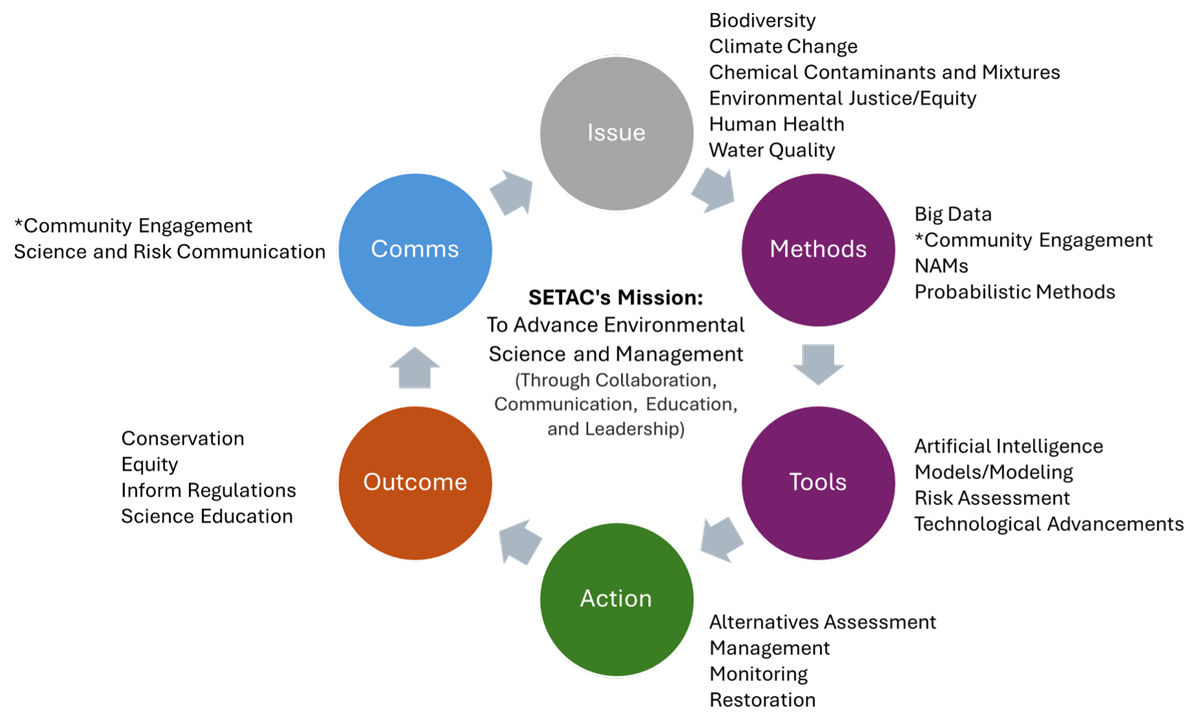
Figure 1. Framework illustrating prioritized scientific keywords across six interconnected categories (issues, methods/data, tools, actions/processes, outcomes, and communications). The framework is relational and intended to support the development of strategic scientific topics by linking elements across categories. SETAC mission statement provided for reference.
Using the Framework to Identify Scientific Priorities
To further synthesize the results, the SC used ChatGPT (GPT-5.3) to explore how categorized keywords could be translated into higher-level scientific themes aligned with SETAC’s mission (center of Figure 1). The following example topics reflect linkages across multiple components of the framework, including issues, methods, tools, actions, outcomes and communications:
- Predictive environmental science to better understand ecosystem and human health under changing conditions
- Innovative and transparent approaches to chemical assessment, including NAMs and big data analytics
- Next-generation tools for environmental monitoring, modeling and decision support
- Integrated systems-based environmental management approaches that address cumulative impacts and real-world complexity
- Biodiversity protection and conservation informed by ecotoxicology
- Environmental justice and equity in exposure, risk assessment and environmental decision-making
- Science communication and community engagement to support informed decision-making and public trust
Together, these themes reflect both continuity with SETAC’s historical strengths and responsiveness to emerging scientific, technological and societal priorities.
Looking Forward
This effort represents an important step toward a more structured and transparent approach for identifying scientific priorities within SETAC North America. The framework developed by the SC provides a consistent and robust foundation for organizing scientific topics and exploring connections across issues, methods, tools, actions, outcomes and communication.
As environmental challenges, scientific capabilities and regulatory needs continue to evolve, the strength of this approach lies in the continued application and refinement of the framework. Through iterative use and engagement with diverse perspectives, the framework can support the identification and refinement of priority topics that remain aligned with SETAC’s global mission while emphasizing emerging needs. Future applications may include periodic reassessment by the SC, engagement with SETAC members to solicit input on emerging priorities, and alignment with BoD-level strategic planning and programming decisions.
Used in this way, the framework itself serves as a guide, but the priorities it helps identify will naturally shift over time. Reapplying the framework as new information and perspectives emerge will allow SETAC North America to maintain a forward-looking and scientifically grounded set of priorities.
By applying this framework over time and leveraging collective expertise across sectors, SETAC North America is well positioned to continue advancing science that is rigorous, relevant, impactful and aligned with its mission.
Any use of trade, firm or product names is for descriptive purposes only and does not imply endorsement by the U.S. Government.